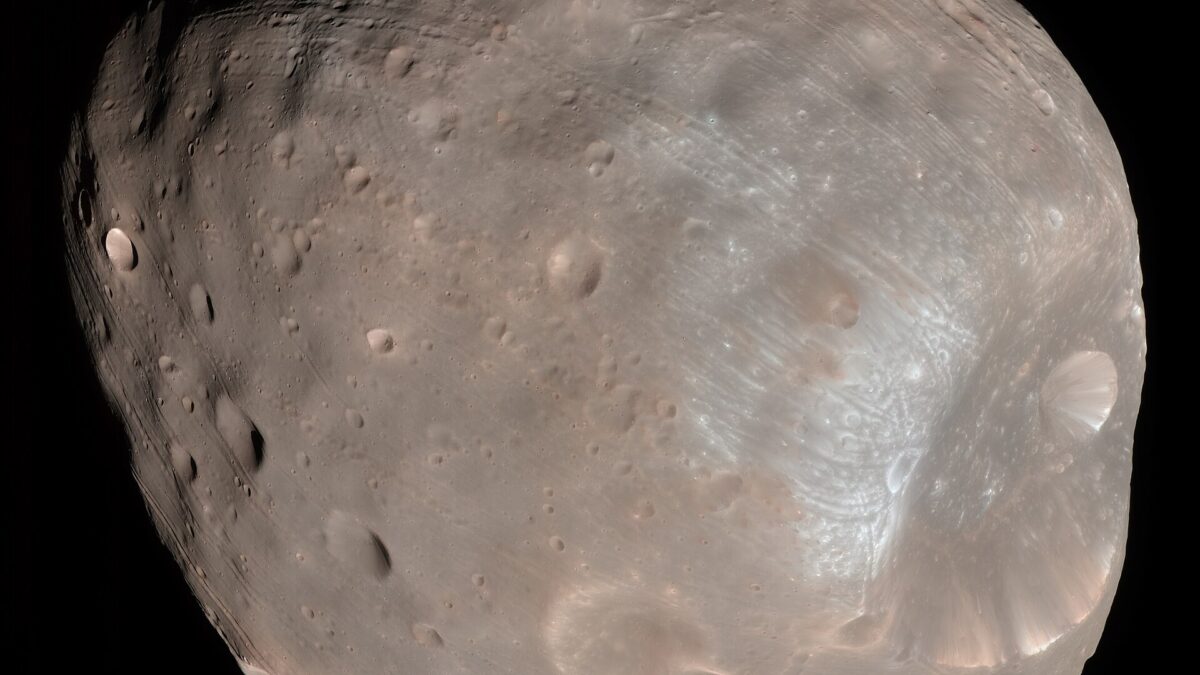
TANEGASHIMA, Japan, Oct. 20 (TodayViralUSA) — Japan’s space agency launched a spacecraft on Tuesday on a first-of-its-kind mission to collect samples from Phobos, the larger of Mars’ two moons, and return them to Earth, with a NASA-funded instrument on board to help settle a long-running debate about where the moon came from.
The Martian Moons eXploration (MMX) probe lifted off on an H3 rocket from the Tanegashima Space Center at 4:41 a.m. local time, or 3:41 p.m. EDT on Monday. The Japan Aerospace Exploration Agency (JAXA) said the rocket flew as planned and the spacecraft separated about 71 minutes after liftoff before being placed in its planned orbit.
An international effort
JAXA leads the mission with NASA, the French space agency CNES, the German Aerospace Center (DLR) and the European Space Agency (ESA). NASA’s main science contribution is MEGANE, a gamma-ray and neutron spectrometer built by the Johns Hopkins Applied Physics Laboratory in Maryland with Lawrence Livermore National Laboratory. It will measure radiation given off naturally by Phobos to reveal its elemental makeup, effectively letting scientists “see” beneath the surface.
“Phobos has long guarded the secrets of its origins, and MEGANE will give us a powerful new way to uncover them,” said David Lawrence, the instrument’s principal investigator at APL. NASA is also supplying a pneumatic sampler technology demonstration and Deep Space Network communications support.
Captured asteroid or crash debris?
Scientists still do not know how Phobos and its smaller sibling, Deimos, formed. One theory holds they are asteroids captured by Mars’ gravity; another says they coalesced from debris blasted into orbit when something large struck the planet. Returned samples could answer the question and shed light on how Mars and the early solar system evolved.
“The data and samples returned by MMX are a window to study the evolution of Mars and the Solar System,” said Elliot Sefton-Nash, ESA’s project scientist for the mission.
The road ahead
MMX is expected to enter orbit around Mars in August 2027 and begin circling Phobos the following month, becoming the first spacecraft to do so. After studying both moons, it will release a 25-kilogram rover named Idefix in early 2029. Gravity on Phobos is so weak that the rover will weigh the equivalent of about 15 grams there, according to ESA.
The main spacecraft is then scheduled to land on Phobos in 2030 to gather samples, with a return capsule carrying at least 10 grams of material due to land in Australia in 2031. It would be the first mission to visit the Mars system and come back to Earth.
Sources & Credits
- JAXA: Launch result of the Martian Moons eXploration (MMX) spacecraft aboard H3 Launch Vehicle flight No.10
- Johns Hopkins APL: Mars-Bound Johns Hopkins APL Instrument to Provide New Look at Martian Moons
- European Space Agency: Mars moon lander set to launch on 19 October
Image: Mars’ moon Phobos imaged by the HiRISE camera on NASA’s Mars Reconnaissance Orbiter, 2008, by NASA / JPL-Caltech / University of Arizona, Public domain, via Wikimedia Commons.


Join the conversation