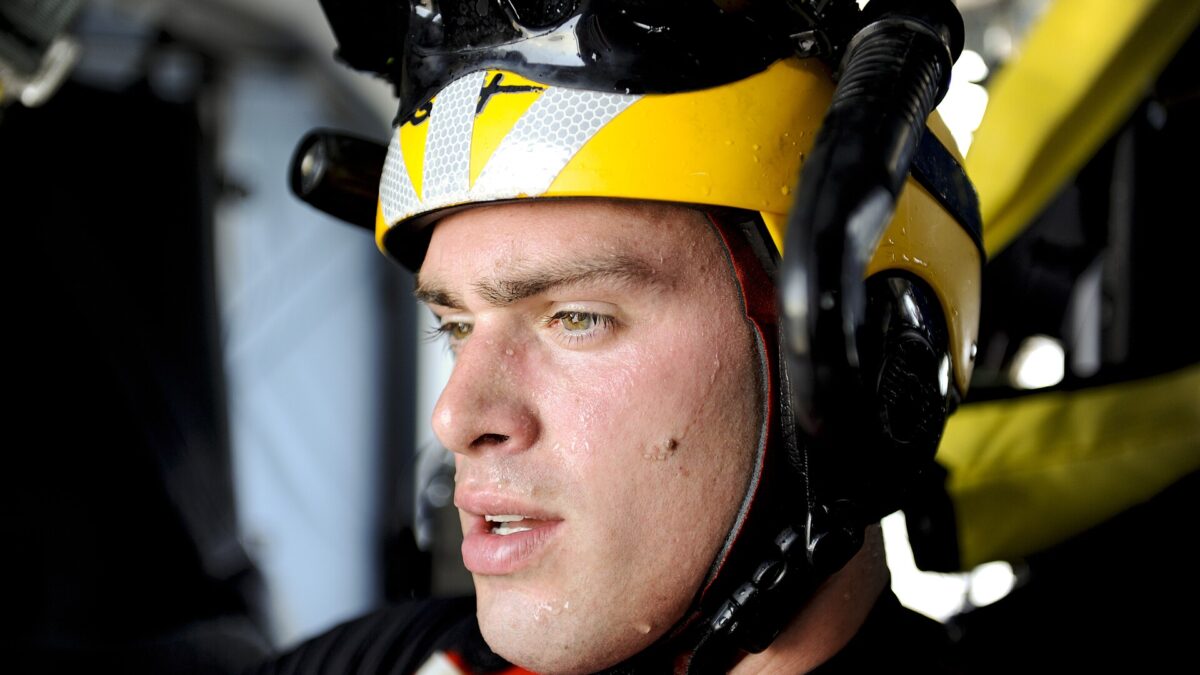
LOS ANGELES, Oct. 24 (TodayViralUSA) — Lowered from a hovering helicopter into the black, churning Pacific roughly 140 miles off Mexico’s Baja California peninsula, U.S. Coast Guard rescue swimmer Josh Law had only a searchlight to guide him toward more than two dozen people who had been thrown into the sea when their boat capsized.
Over the next two hours, in the predawn darkness of Oct. 16, the 24-year-old would personally bring 16 of them to safety. Eleven others were never found.
“Nothing compared to what they were” facing
In his first interview since the rescue, Law told The Associated Press that he was the only rescuer in the water that night. Waves of 6 to 8 feet broke over him, and the downwash from the helicopter’s rotor whipped up so much spray and noise that he could neither hear nor see much beyond the light.
He reached the survivors one at a time, turned them onto their backs and used a “buddy tow,” swimming with an arm across their chest, to carry each of them to a spot where the flight mechanic could lower a rescue basket.
“I was experiencing exhaustion at that point,” Law said. “We had very little sleep. But what I was experiencing was nothing compared to what they were at that point … I just had to keep that in mind.”
Shark-bite injuries and a long search
On the flight back, Law treated three people with serious wounds, working to stop the bleeding. The Coast Guard said several of the injuries were consistent with shark bites. Survivors were flown to San Diego and taken to hospitals. It was by far the longest rescue Law had ever carried out before his crew returned to its base in Ventura County.
The Coast Guard, working with Mexico and the U.S. Navy, searched more than 2,441 square miles over a combined 89 hours for the 11 people still missing before suspending the effort late Sunday, Oct. 18.
Questions about the voyage
The area is a remote route often used by migrant-smuggling boats, and what the vessel was doing so far offshore is now part of a federal investigation. It remains unclear whether it got lost, lost power or was carried out to sea. Only pieces of the boat were recovered.
All of those rescued are Mexican nationals, according to the Mexican consulate. Customs and Border Protection said the survivors would be processed under immigration law once medically cleared, and U.S. officials said nearly half have since been returned to Mexico.
Sources & Credits
- AP News: 24-year-old Coast Guard swimmer says he fought waves and darkness to rescue 16 people from ocean
- NBC 7 San Diego: Coast Guard swimmer, 24, says he rescued 16 people from ocean
- AP News: Search ends for more survivors from boat that sank off Mexico coast
Image: Coast Guard rescue swimmer inside an MH-60 Jayhawk during hoist training (file photo, not from this rescue), by Petty Officer 1st Class Brandyn Hill, U.S. Coast Guard, public domain, via Wikimedia Commons.


Join the conversation