WASHINGTON, Nov. 24 (TodayViralUSA) — Fewer Americans plan to shop over the Thanksgiving holiday weekend this year as households spread purchases across the season and keep a closer eye on budgets, though retailers and analysts still expect online spending during the stretch to reach new highs.
An estimated 182.7 million consumers plan to shop between Thanksgiving Day and Cyber Monday, according to the National Retail Federation’s annual survey conducted by Prosper Insights & Analytics. That is down from 186.9 million last year, though the trade group said it continues a pattern of elevated holiday-weekend shopping seen in recent years.
Shopping pulled forward
Sixty percent of consumers had started their holiday shopping by early November, up from 56% before the pandemic, the survey found. “Holiday shopping continues to be pulled forward, but Thanksgiving weekend remains an important shopping event for consumers,” said Allison Zeller, NRF’s vice president of industry and consumer insights.
Black Friday, which falls on Nov. 27, remains the weekend’s busiest day, with 69% of holiday shoppers — about 126 million people — planning to shop. Of those, 67% expect to shop in stores and 89% online. Cyber Monday ranks second, with 36%, or 66.1 million people.
Budgets under pressure
Price sensitivity is a defining theme. Eighty-two percent of shoppers say they are taking steps to manage costs, including buying less expensive gifts (25%), cutting back elsewhere (24%), buying for fewer people (20%) or holding off until Thanksgiving weekend to do most of their shopping (20%). Deals “too good to pass up” were the top reason cited for shopping over the holiday weekend, at 48%.
Gift cards are losing ground. Only 39% of shoppers plan to give them, the lowest share in the survey’s more than 20-year history, and total gift card spending is projected at $26.8 billion, the lowest since 2015. Clothing and accessories (45%) remain the most popular planned gift, followed by gift cards and toys (29%).
Artificial intelligence has also moved into the mainstream of holiday shopping: 59% of Thanksgiving weekend shoppers plan to use AI tools, most commonly for product recommendations, gift ideas and price comparisons.
Online sales still expected to hit records
Fewer shoppers does not necessarily mean less spending. Adobe, which tracks transactions on U.S. retail websites, forecasts $12.9 billion in online sales on Black Friday, up 9.2% from last year, and a record $15.1 billion on Cyber Monday, up 6.2% — the first time a single day would top $15 billion in U.S. e-commerce. Adobe expects the five days from Thanksgiving through Cyber Monday to generate $47.5 billion online, up 7.4%, with Thanksgiving Day itself contributing $6.9 billion.
Adobe said Black Friday is growing faster than Cyber Monday in part because it carries the deepest discounts in categories such as televisions, apparel and appliances, with discounts across the season expected to reach up to 30% off listed prices. For the full November–December period, Adobe projects online spending of $275.1 billion, up 6.7%.
The bigger picture
The NRF forecasts total holiday retail sales for November and December will rise 4.2% to $1.013 trillion, compared with $972 billion last year. “Consumers will prioritize the holiday season even as they remain mindful of their budgets,” NRF President and CEO Matthew Shay said when the forecast was released. NRF chief economist Mark Mathews cautioned that inflation, rising gas prices and household financial pressure “will affect consumers differently across income groups.”
Sources & Credits
- National Retail Federation: 183 Million Consumers Expected to Shop During Thanksgiving Weekend
- National Retail Federation: NRF Forecasts 2026 Holiday Sales Growth as Consumers Remain Resilient
- Adobe: Adobe: U.S. Holiday Shopping Season to Hit Record $275.1 Billion Online, Rising 6.7% YoY
- Retail Dive: Black Friday, Cyber Monday shopping projected to slip
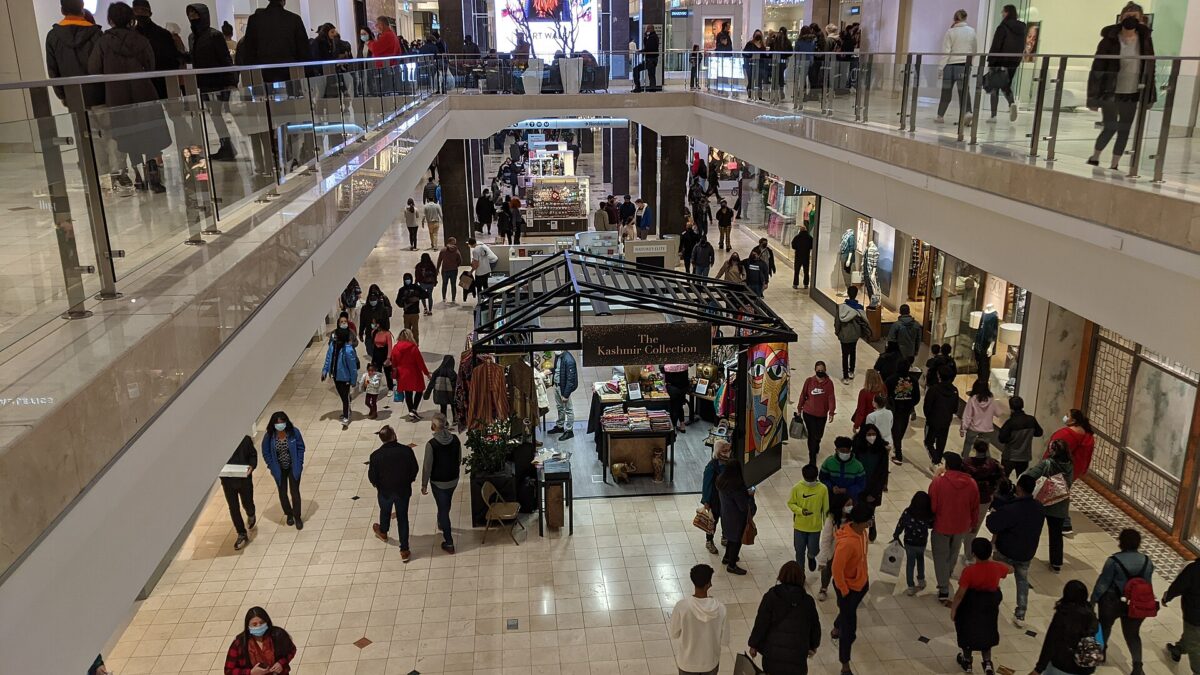
Image: Shoppers at Westfield Montgomery mall in Bethesda, Md., on Black Friday 2021. Photograph by G. Edward Johnson, CC BY 4.0, via Wikimedia Commons.



Join the conversation