The 2026–27 flu season is arriving weeks ahead of schedule in the United States, with hospital admissions for influenza nearly tripling between early September and early October and a fast-spreading strain of H1N1 prompting specialists to urge Americans not to delay their annual shots.
Hospitals reported 3,334 laboratory-confirmed flu admissions in the week ending Oct. 3, according to Centers for Disease Control and Prevention data, up from 2,572 the prior week and 1,133 in the week ending Sept. 5. The national admission rate climbed to 1.0 per 100,000 people, from 0.3 in early September.
The CDC said national activity is “higher than typically observed at this time of year” but still “within expected seasonal variation.”
West Coast running hot
The early surge is most pronounced in the West. In the federal health region covering Arizona, California, Hawaii and Nevada, flu test positivity is running near 9.5%, close to last season’s peak of roughly 11.5%. Nationally, 3.6% of the 39,317 specimens tested by clinical labs were positive, up from 1.3% in early September, and influenza A accounted for 97% of positives.
“It would be an incredibly early season” for the U.S. if West Coast cases keep rising at their current pace, University of Pennsylvania virologist Scott Hensley told the journal Nature.
Independent health-record data point the same way. Truveta, a data company owned by U.S. health systems, found that flu-associated hospitalizations in late September were nearly three times higher than at the same point in any of the previous six seasons, and rose more than 2.5 times faster. Epic Research reported that flu encounters in mid-September were roughly double the rate seen at the same time in 2024 and 2025, arriving about seven weeks earlier.
A mutation under watch
H1N1 has displaced H3N2 as the dominant subtype, accounting for about 98% of subtyped influenza A samples in recent CDC data. Researchers are tracking a mutation in that virus, known as G155E, that appears to help some strains evade existing immunity.
A preprint led by Jesse Bloom of the Fred Hutchinson Cancer Center found that antibodies in blood from teenagers and young adults were especially poor at recognizing strains carrying the change. A University of Washington lab detected the mutation in 13 of 17 fully sequenced H1N1 samples from Seattle-area hospitals and clinics.
Experts caution that an early start does not necessarily signal a severe season. “An early start doesn’t necessarily mean a more severe season,” said University of Oxford epidemiologist James Hay.
Vaccination timing
Outpatient visits for flu-like illness remain below the national baseline, at 1.8% versus 3.1%, but emergency department flu diagnoses have tripled since early September, and four metro areas reported high activity in the latest week.
The CDC recommends annual flu vaccination for everyone 6 months and older, ideally by the end of October. Some specialists, including Johns Hopkins epidemiologist Caitlin Rivers, have said they plan to get vaccinated as soon as possible this year rather than waiting until later in the fall.
The season that just ended recorded 198 flu-associated pediatric deaths, according to the CDC.
Sources & Credits
Reporting based on: Becker’s Hospital Review; Nature; Truveta Research; Epic Research; CDC FluView.
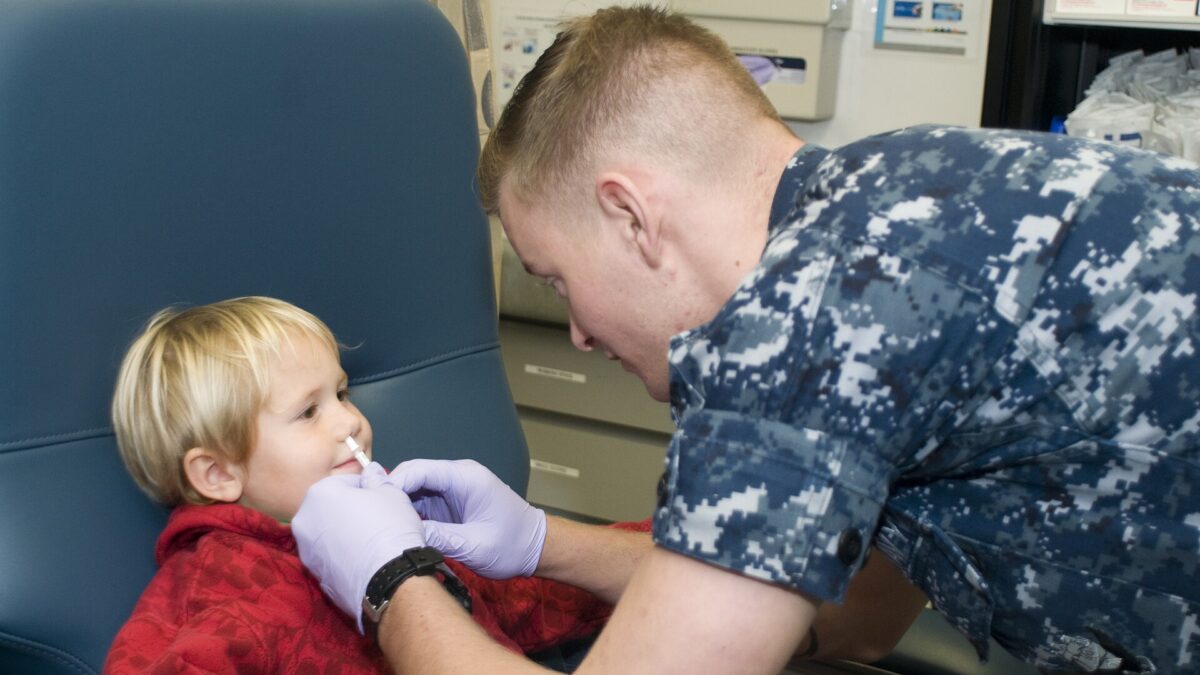
Image: A U.S. Navy corpsman administers a nasal flu vaccine to a child (file photo) — Christine Cabalo, U.S. Department of Defense / Wikimedia Commons (Public domain).



Join the conversation