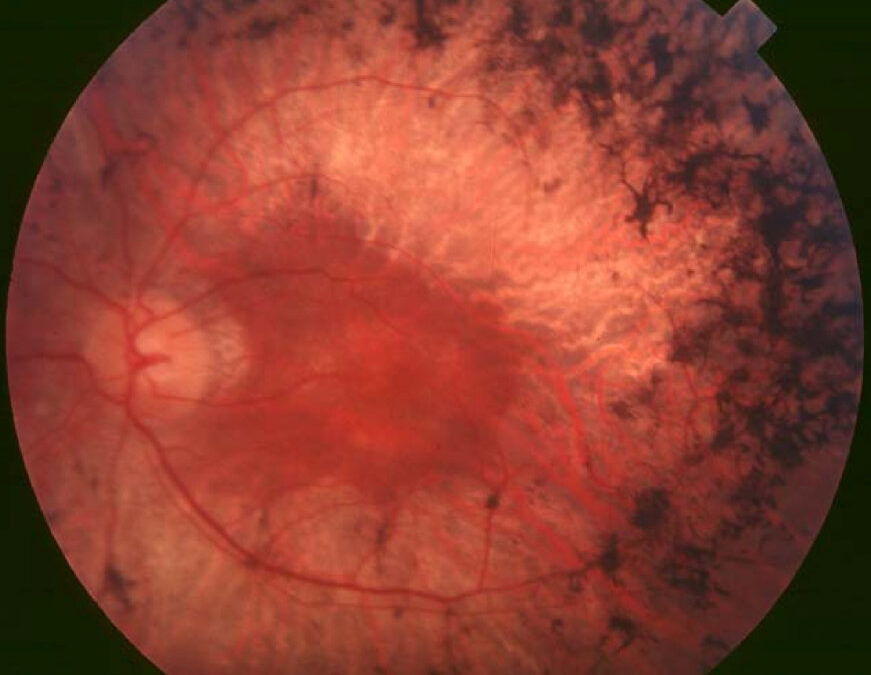
An experimental gene therapy that turns surviving retinal cells into light sensors, paired with camera-equipped goggles, improved light sensitivity in seven of 10 people left legally blind by retinitis pigmentosa, according to results published in the New England Journal of Medicine.
Six of the seven patients showed gains large enough to be considered clinically meaningful. The treatment did not restore normal sight or the ability to read, but some participants became better at detecting, locating and reaching for objects while wearing the goggles.
A gene-agnostic approach
Retinitis pigmentosa destroys the retina’s light-sensing rod and cone cells and affects more than 1.5 million people worldwide. Because mutations in more than 100 different genes can cause it, repairing the disease one gene at a time has proved slow and costly.
The therapy, an approach known as optogenetics, takes a different route. Even after rods and cones die, retinal ganglion cells often survive. Doctors used a single injection into one eye to deliver a gene for a light-sensitive protein called ChrimsonR into those cells. Because the protein responds to specific wavelengths and intensities that everyday light does not reliably provide, patients wear goggles whose camera feeds a portable processor that converts the scene into tailored light patterns projected into the treated eye.
What the trial showed
The results come from PIONEER, a first-in-human, open-label study led by researchers at the University of Pittsburgh and UPMC with international collaborators. It tested three dose levels in 10 people with advanced disease. Brain recordings in some participants showed visual signals reaching the visual cortex, and four of the eight who completed behavioral testing improved consistently on real-world tasks over months to years.
“The visual system retains a remarkable capacity to process new information,” said Dr. José-Alain Sahel, the study’s first author and chair of ophthalmology at the University of Pittsburgh.
Most side effects were mild or moderate, including temporary inflammation and brief rises in eye pressure. One serious event, a short-lived blockage of the central retinal artery immediately after injection, resolved within minutes with eye drops.
Important caveats
The trial was designed primarily to test safety, and its efficacy findings are exploratory: there was no control group, no blinding and only 10 participants. The work was supported by GenSight Biologics, the French company developing the therapy, which Sahel co-founded. The therapy is not approved and is available only through clinical research, and larger controlled trials will be needed to confirm the benefits.
Sources & Credits
Reporting based on: Medical Daily; The New England Journal of Medicine.
Image: “Fundus of patient with retinitis pigmentosa, mid stage” by Christian Hamel, CC BY 2.0, via Wikimedia Commons.
Join the conversation