A federal judge late Tuesday barred the Trump administration from shutting CNN, MS NOW and Politico out of the White House while the three news organizations pursue their lawsuit over the president’s ban, handing the outlets their most durable legal win yet in an escalating fight between the administration and the press corps that covers it.
U.S. District Judge Timothy J. Kelly of Washington, D.C., issued a preliminary injunction that keeps the outlets’ reporters on the White House grounds until the case is decided, a process that could take months or longer. The order replaces a temporary restraining order Kelly first granted on Sept. 24 and later extended through Oct. 13.
Judge points to the president’s own words
Kelly, who was appointed by President Donald Trump, concluded that the ban on more than 70 journalists likely violated the outlets’ First Amendment protections for speech and newsgathering as well as their due-process rights. In reaching that finding, he relied heavily on Trump’s public statements and social media posts, rejecting the Justice Department’s argument that the move was driven by national security concerns.
“President Trump’s own comments suggest that he intended the revocation of Plaintiffs’ hard passes to alter their reporting on him,” Kelly wrote. Elsewhere in the opinion he added: “It is not hard to conclude that President Trump likely banned Plaintiffs from the White House because he believes that their reporting is generally inaccurate and biased against him.”
The judge noted that the national security rationale surfaced only in court filings days after the ban took effect, and that the outlets received no advance notice or meaningful chance to contest it. At the same time, he cautioned that his ruling should not be read as dismissing the government’s concerns outright. “No one should interpret the Court’s decision to suggest that President Trump’s concerns about accuracy and fairness in the media’s reporting are unfounded,” he wrote, “or that the government is powerless when its true aim is to protect national security when classified information is unlawfully disclosed.”
Limits of the order
The injunction restores access to the White House complex and its press areas, but it does not require the administration to admit the outlets’ reporters to tighter spaces such as the Oval Office or Air Force One. The White House has repeatedly kept CNN and Politico out of those venues in recent weeks, which has prevented CNN from taking its turn representing the television pool, the cost-sharing arrangement with ABC, CBS, Fox and NBC that records the president’s public appearances.
Theodore J. Boutrous, the First Amendment lawyer representing the three organizations, said the president “blatantly and explicitly violated due process and the First Amendment” when he imposed the ban, and has since “repeatedly, candidly, and consistently admitted in public” that he did so to punish coverage he dislikes. The White House did not immediately respond to requests for comment.
A widening confrontation with the press
Trump announced the ban on Sept. 18 in a social media post that cited what he called the outlets’ “FAKE NEWS.” Members of the broader White House press pool have since stood with the barred organizations, declining White House invitations to fill CNN’s and Politico’s pool positions, and some outlets have withheld images from the still-photography pool.
The dispute has spilled into other arenas. Last week the Justice Department said it was investigating CNN, ABC, CBS, NBC and Fox News for possible antitrust violations after the networks temporarily stopped providing pool coverage in response to the ban. The administration is expected to continue contesting the case as it moves toward a possible trial on the First Amendment claims.
Sources & Credits
Reporting based on: NPR; Associated Press; NBC News; Axios.
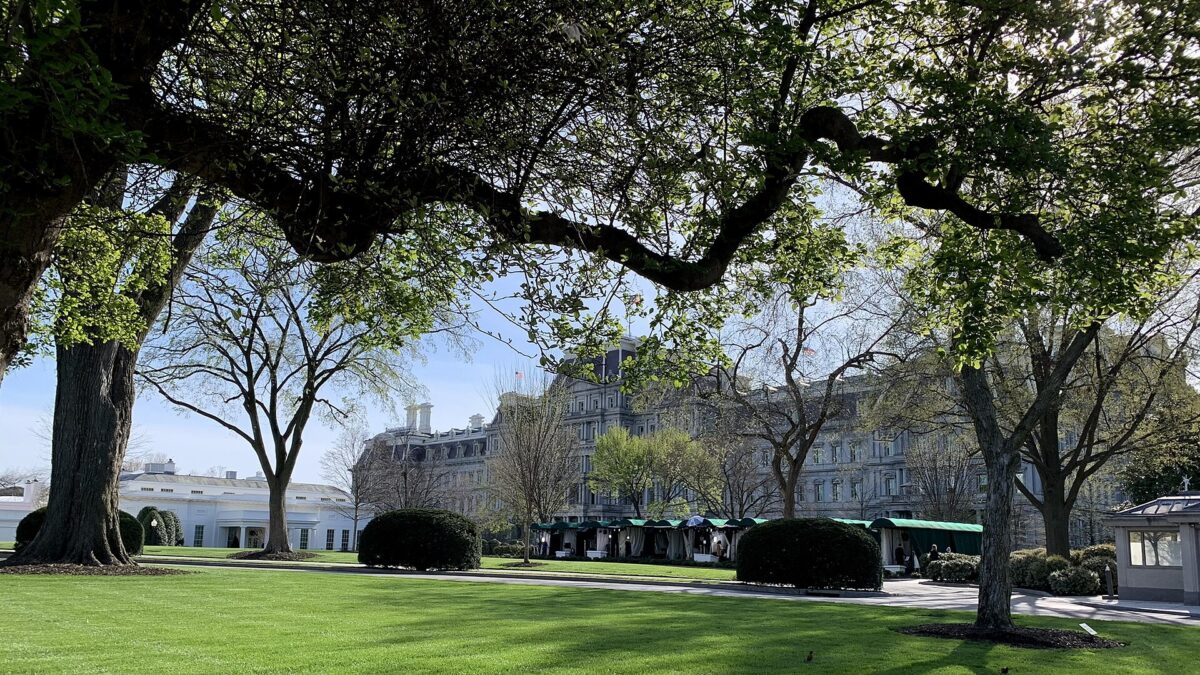
Image: “White House press tents” by APK, CC BY-SA 4.0, via Wikimedia Commons.
Join the conversation