WASHINGTON, Nov. 28 (TodayViralUSA) — The Supreme Court will hear arguments on Wednesday in a case that could decide whether states and cities may ban AR-15-style rifles, placing the conservative-majority court at the center of one of the most fiercely contested questions in American gun law.
The justices will consider two consolidated challenges, Khaya v. Cook County and Grant v. Higgins, which target an assault weapons ordinance in Cook County, Illinois, and Connecticut’s statewide ban on semiautomatic rifles. The court agreed this summer to take up the cases, and argument is set for Dec. 2.
What is at stake
About a dozen states have laws banning weapons such as the AR-15, covering major cities including New York, Los Angeles and Chicago, the Associated Press reported. A federal law restricting the manufacture and sale of such guns expired in 2004, and the rifles have since become far more common as prices fell.
Gun rights advocates, backed by the Trump administration, argue that it is unconstitutional to ban the most widely owned rifle in the country. Challengers cite a 2026 survey estimating that Americans own about 40 million AR-15-type rifles.
“This is the biggest and most pernicious problem we have in the gun control space,” Bill Sack, senior director of legal operations at the Second Amendment Foundation, told the AP. “We all view this as the Super Bowl of gun rights for the time being.”
The Second Amendment Foundation brought both cases. It is joined in the Cook County challenge by the Firearms Policy Coalition and in the Connecticut case by the Connecticut Citizens Defense League, along with individual gun owners.
The “common use” question
The case is the latest test of the court’s landmark 2022 decision in New York State Rifle & Pistol Association v. Bruen, which held that gun restrictions must be consistent with the nation’s historical tradition of firearms regulation. That ruling unleashed a wave of lawsuits, and lower-court judges have since expressed confusion about how to apply its test.
A central issue is whether the widespread ownership of semiautomatic rifles means they cannot be subject to a blanket ban. The administration argues that while bans on especially dangerous weapons such as machine guns have been upheld, there is no historical basis for prohibiting firearms “in common use” by law-abiding citizens.
Connecticut and Cook County counter that the rifles were originally designed as weapons of war and that their high-velocity rounds cause “catastrophic damage” to the human body. “Once it becomes clear that a new weapon poses an unacceptable threat to human life, legislatures should be able to act,” lawyers for Cook County wrote.
So far, courts — particularly in Illinois — have largely sided with governments defending the bans, including the U.S. Court of Appeals for the Seventh Circuit, according to the Cook County Record.
Survivors head to Washington
Families and survivors of mass shootings plan to travel to the capital for the argument. Among them is Nicole Hockley, co-founder of Sandy Hook Promise, whose 6-year-old son Dylan was among 20 children and six staff members killed at Sandy Hook Elementary School in 2012 by a gunman with an AR-15-style rifle. She helped persuade Connecticut to expand its ban after the massacre.
“This isn’t just about laws. This is about people, and this is about ensuring that people are protected,” Hockley told the AP.
Semiautomatic rifles have been used in several of the nation’s deadliest mass shootings, including in Uvalde, Texas, at a Las Vegas music festival and at the 2022 Independence Day parade in Highland Park, Illinois. Northeastern University criminologist James Alan Fox said such attacks have killed nearly twice as many people on average as other mass shootings, though most mass shootings — and most gun violence overall — involve handguns.
UCLA law professor Adam Winkler questioned how much the eventual ruling will change public safety. “I don’t think it’s going to have a big impact on public safety either way,” he said.
A last-minute procedural fight
The Cook County case survived a late attempt to derail it. After one of the lead plaintiffs, Cutberto Viramontes, asked to leave the case, Cook County State’s Attorney Eileen O’Neill Burke argued that the challenge had become moot. On Nov. 23 the justices allowed Viramontes to exit, and on Nov. 24 they deferred any ruling on mootness until after oral argument, leaving co-plaintiff Christopher Khaya as the lead named challenger, the Cook County Record reported.
Illinois’ own statewide ban, passed in 2023 after the Highland Park shooting, is not directly before the court, but a broad ruling against the Cook County and Connecticut laws would likely doom similar measures elsewhere.
A decision is expected around the end of June.
Sources & Credits
- CNBC / Associated Press: Supreme Court to decide if assault weapons bans violate 2nd Amendment
- Cook County Record: SCOTUS won’t let Cook County use technicality to exit gun ban challenge
- Second Amendment Foundation: Fact sheet provides guide to Supreme Court’s Second Amendment cases ahead of oral argument
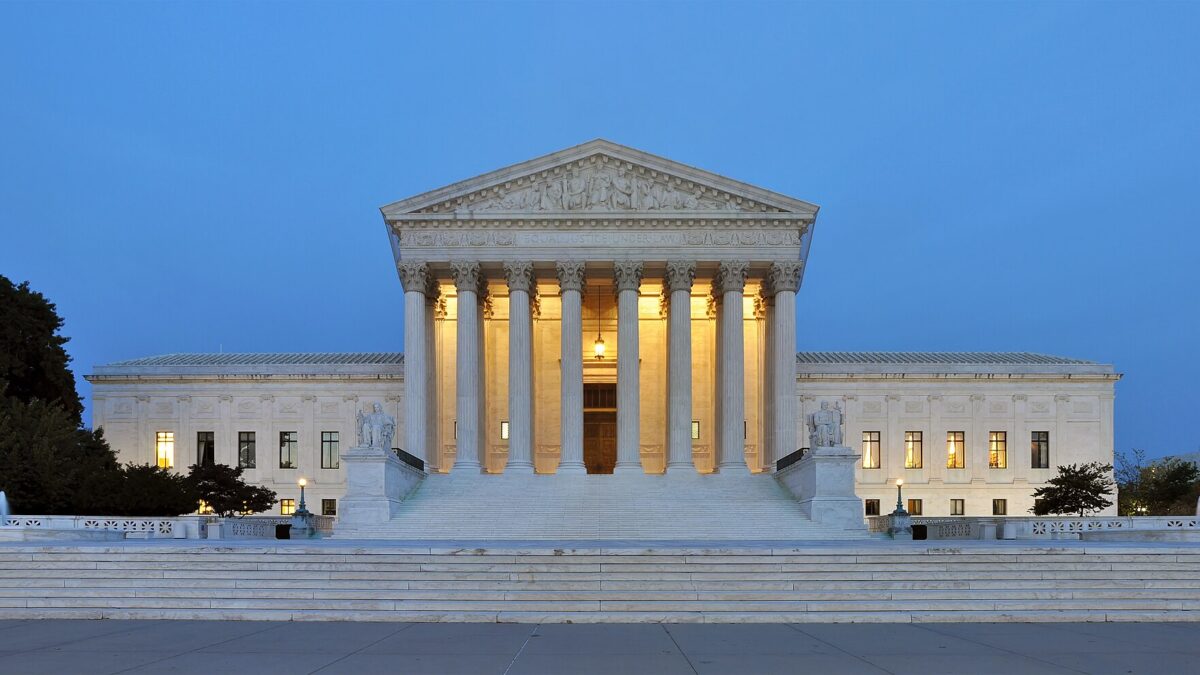
Image: The west facade of the U.S. Supreme Court Building in Washington at dusk (file photo). Photo: Joe Ravi, CC BY-SA 3.0, via Wikimedia Commons.



Join the conversation