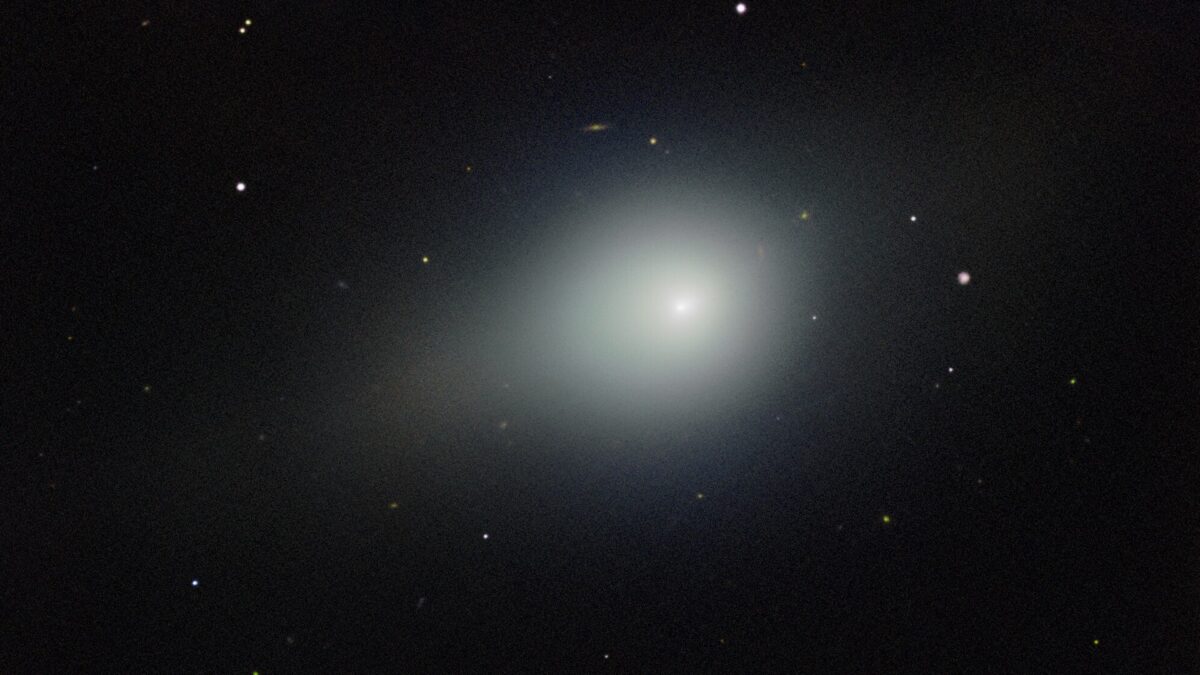
SAN ANTONIO, Oct. 27 (TodayViralUSA) — Ice streaming from 3I/ATLAS, only the third object from another star ever spotted passing through our solar system, looks strikingly like the ice found on frozen worlds orbiting beyond Neptune, according to a new study using NASA’s James Webb Space Telescope.
The finding, led by researchers at the Southwest Research Institute and published in The Astrophysical Journal Letters, suggests that the icy building blocks of planets around other stars may share a common range of physical properties with those in our own cosmic neighborhood.
A puzzle in the infrared
Water ice leaves telltale “fingerprints” in infrared light: a deep absorption band near 3 microns and two weaker bands near 1.5 and 2.0 microns. Most icy comets show all three. In 3I/ATLAS, the 3-micron band is strong, but the shorter-wavelength bands are very weak or missing.
“That combination was a puzzle,” said lead author Silvia Protopapa of the Southwest Research Institute. Modeling pointed to an explanation: the comet’s coma is filled with grains about a micron or smaller made of water ice mixed with dust. In such dusty grains, light travels only a short distance through the ice, muting the weaker bands.
“The grains of 3I/ATLAS are about the same size as those in our own comets,” Protopapa said. “What seems to set them apart is how much dust is mixed into the ice.”
Watching a visitor change
The team observed the comet with Webb’s Near-Infrared Spectrograph three times between August 2025 and April 2026, before and after its closest approach to the sun. By the final observation, the data favored an additional population of larger, more ice-rich grains.
Researchers say they cannot yet tell whether that shift reflects the sun heating the grains differently or fresh material exposed as the comet’s surface eroded.
At home among distant icy worlds
When the team compared 3I/ATLAS with Webb observations of trans-Neptunian objects, icy bodies thought to preserve material from the early solar system, the shape of its 3-micron water-ice band resembled that of several groups of those objects, which also lack strong shorter-wavelength bands.
“At first glance, 3I/ATLAS looks different from the icy comets we know,” Protopapa said. “But when we placed it alongside distant icy worlds in our own solar system, it no longer looked out of place.”
If confirmed, the researchers say, the physical form of water ice may be set early in planet-forming disks and partly preserved in the icy bodies born there. Future Webb observations of comets and new interstellar visitors will test whether 3I/ATLAS is typical.
Sources & Credits
- Phys.org / Southwest Research Institute: Webb links interstellar comet 3I/ATLAS to worlds beyond Neptune through similar ice signatures
- The Astrophysical Journal Letters: Protopapa et al., JWST Reveals Refractory-rich Water Ice in Interstellar Comet 3I/ATLAS (DOI: 10.3847/2041-8213/aea60d)
Image: Interstellar comet 3I/ATLAS imaged by the Gemini Observatory (file photo), International Gemini Observatory/NOIRLab/NSF/AURA/B. Bolin, CC BY 4.0, via Wikimedia Commons.



Join the conversation