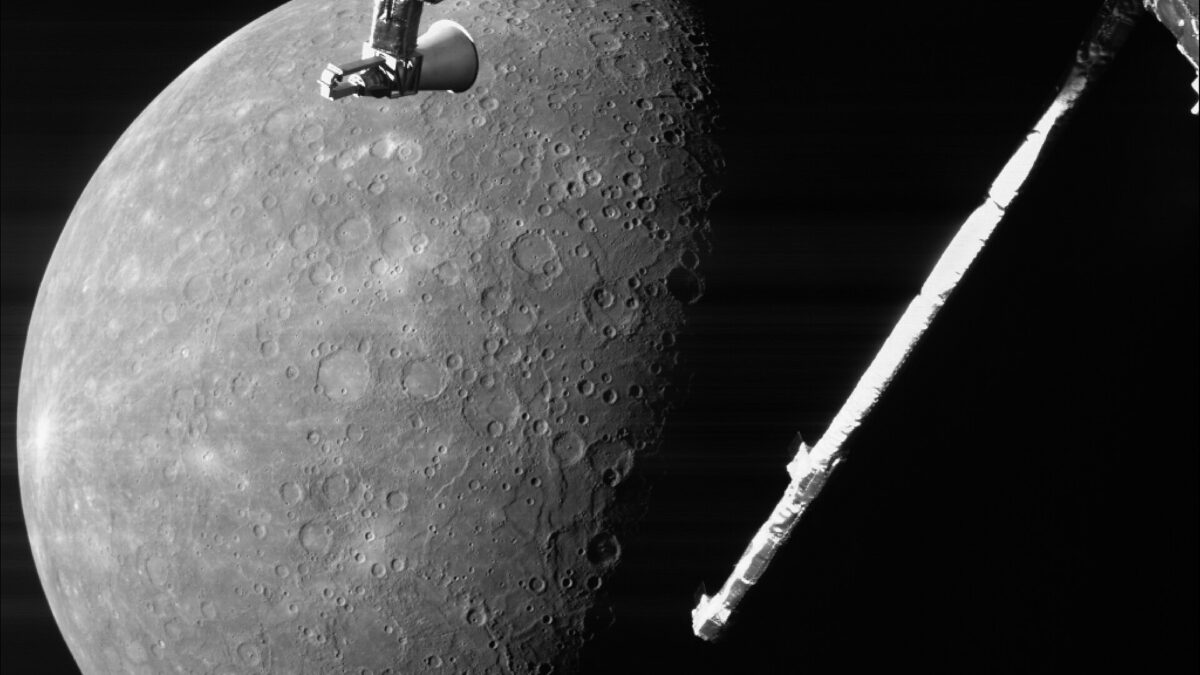
DARMSTADT, Germany, Nov. 24 (TodayViralUSA) — The joint European-Japanese BepiColombo spacecraft is in a stable orbit around Mercury after an eight-year voyage, mission controllers said, despite a software glitch that cut short the critical engine burn meant to secure its capture by the solar system’s innermost planet.
The European Space Agency said the spacecraft remains on track to release its two science orbiters on Dec. 9, a milestone that sets up the most detailed study of Mercury yet attempted.
A burn cut short
The Mercury orbit insertion maneuver began at 18:24 UTC on Nov. 21, as the spacecraft passed about 635 kilometers (roughly 395 miles) above Mercury’s surface. Commands had been uploaded in advance, and the spacecraft had turned away from Earth for the burn, producing a planned communications blackout. Its four axial thrusters were set to fire for about 37 minutes.
When contact was restored through ESA’s New Norcia deep-space antenna in Australia, telemetry showed the burn had been interrupted automatically and the spacecraft had placed itself in safe mode, a protective state that halts nonessential activity. Analysis found the maneuver had delivered about 77% of the planned change in velocity.
“Upon finding Bepi in safe mode, it was like flipping a switch. Everybody was focused in understanding what had happened,” said Ignacio Tanco, ESA’s BepiColombo flight operations director.
Hours of trajectory analysis followed before the flight dynamics team delivered the answer over the voice loop at about 1 a.m. local time. “We confirm Mercury orbit capture!” announced Frank Budnik, ESA’s flight dynamics manager for the mission.
Software issue identified
Teams at ESA’s European Space Operations Centre in Darmstadt and lead manufacturer Airbus have traced the anomaly to a software problem involving attitude guidance and thruster control, and the investigation is continuing, the agency said.
The shortened burn left BepiColombo in a 75-hour orbit rather than the 58-hour orbit originally planned. ESA said the remaining series of orbit-lowering maneuvers has already been redesigned around the new trajectory without the need for additional burns, and that the change will not affect the release of the Japanese orbiter or the European orbiter’s ability to reach its planned science orbit.
A first for planetary exploration
BepiColombo is the first spacecraft to enter orbit around another planet using a technique known as weak stability capture, arriving at lower speed than is typical so that the planet’s gravity can loosely capture it. The approach had previously been used only by some missions to the Moon. Solar electric propulsion and nine planetary flybys slowed the spacecraft over its journey, but engine burns are still needed to turn that temporary capture into a lasting orbit.
ESA said a sequence of shorter burns, each timed for the spacecraft’s closest approach to Mercury, uses propellant more efficiently than a single long firing and lets controllers tailor each maneuver to the orbit actually achieved.
What comes next
Launched in October 2018, BepiColombo carries two orbiters: ESA’s Mercury Planetary Orbiter (MPO), which will study the planet’s interior and surface, and the Japan Aerospace Exploration Agency’s Mercury Magnetospheric Orbiter, known as Mio, which will examine the planet’s magnetic environment. The pair are scheduled to separate on Dec. 9 (Dec. 10 in Japan), and Mio’s protective sunshield will be jettisoned on Dec. 16.
Further thruster firings will guide MPO into its final orbit by March 2027, with science operations planned to begin in April 2027. “Our almost 600-strong science team will be delighted to see BepiColombo pass this key milestone,” said Geraint Jones, ESA’s lead project scientist for the mission.
Sources & Credits
- European Space Agency: BepiColombo safely in Mercury orbit despite unexpected challenge
- CBS News: Spacecraft enters Mercury’s orbit after 8-year journey despite glitch
- European Space Agency: BepiColombo entering orbit around Mercury
Image: Mercury photographed by BepiColombo’s monitoring camera during its fourth flyby on Sept. 5, 2024. Image: ESA/BepiColombo/MTM, CC BY-SA 3.0 IGO, via Wikimedia Commons.

Join the conversation