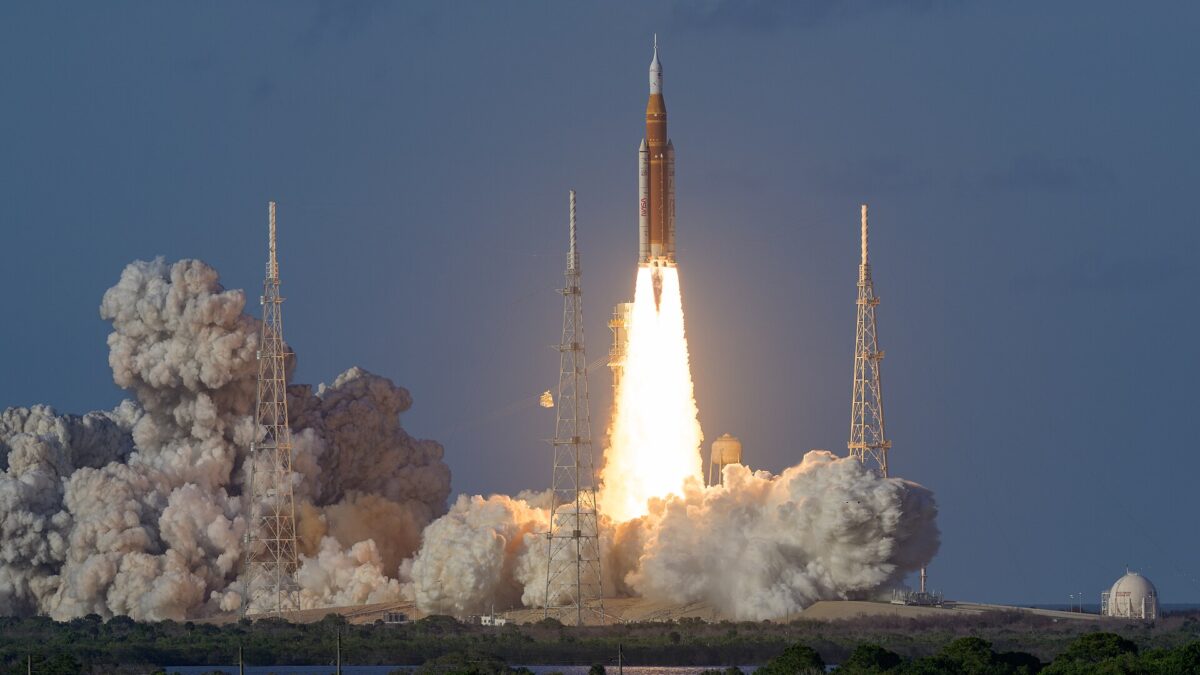
CAPE CANAVERAL, Fla., Nov. 8 (TodayViralUSA) — The launch of NASA’s Artemis II moon mission in April tore two vast holes in Earth’s upper atmosphere that briefly degraded GPS accuracy across North America, according to a new study, raising questions about how a coming wave of deep-space missions could affect the navigation signals that everyday technology depends on.
Researchers at National Cheng Kung University in Taiwan found that the disturbances in the ionosphere, the electrically charged layer of the atmosphere that begins about 30 miles up, were stronger than those caused by any rocket launch studied so far and up to 10 times more intense than those seen during SpaceX’s Starship test flights. The findings appear as a preprint in the journal Geophysical Research Letters.
Two 3,100-mile ‘contrails’
The team reconstructed the effects using high-precision networks of ground-based GPS receivers that U.S. scientists normally use to track tiny movements of tectonic plates. By measuring delays in signals traveling from satellites to the ground, they could map how the passage of the Space Launch System rocket changed the density of free electrons overhead.
One hole was left by the rocket’s 212-foot core stage; the other by two later burns of its upper stage, which fired about 115 miles up, inside the ionosphere itself, more than an hour after liftoff to send the Orion capsule toward the moon. Each disturbance stretched roughly 3,100 miles (5,000 kilometers) across the continent from east to west, and the upper-stage burns produced the more prominent effect, Space.com reported.
Meters of error, and a warning for the future
The changes were equivalent to GPS positioning errors of several meters. Rocket-driven disturbances fade far faster than those from severe solar storms, which can disrupt signals for days, but even short-lived errors matter for some technologies, said co-author Charles Lin, an earth science professor at the university. “A positioning error of a couple of meters is enough to cause an autonomous car to change lanes,” he told Space.com, adding that it could also affect drone positioning.
Lin said the team had never seen such an effect from an orbital maneuver on an interplanetary mission, and warned that as more missions head to the moon and Mars, “these space weather effects will become much more significant.”
Sources & Credits
- Space.com: NASA’s Artemis II moon launch tore a hole in Earth’s upper atmosphere so huge it disrupted GPS signals
- TechSpot: The NASA Artemis II launch punched two 5,000 km holes in the ionosphere that disrupted GPS signals, study finds
- Newsweek: Artemis II Tore ‘Hole’ in Earth’s Atmosphere, Raising GPS Concerns
Image: NASA’s Space Launch System lifts off on the Artemis II mission, NASA photo, public domain, via Wikimedia Commons.


Join the conversation