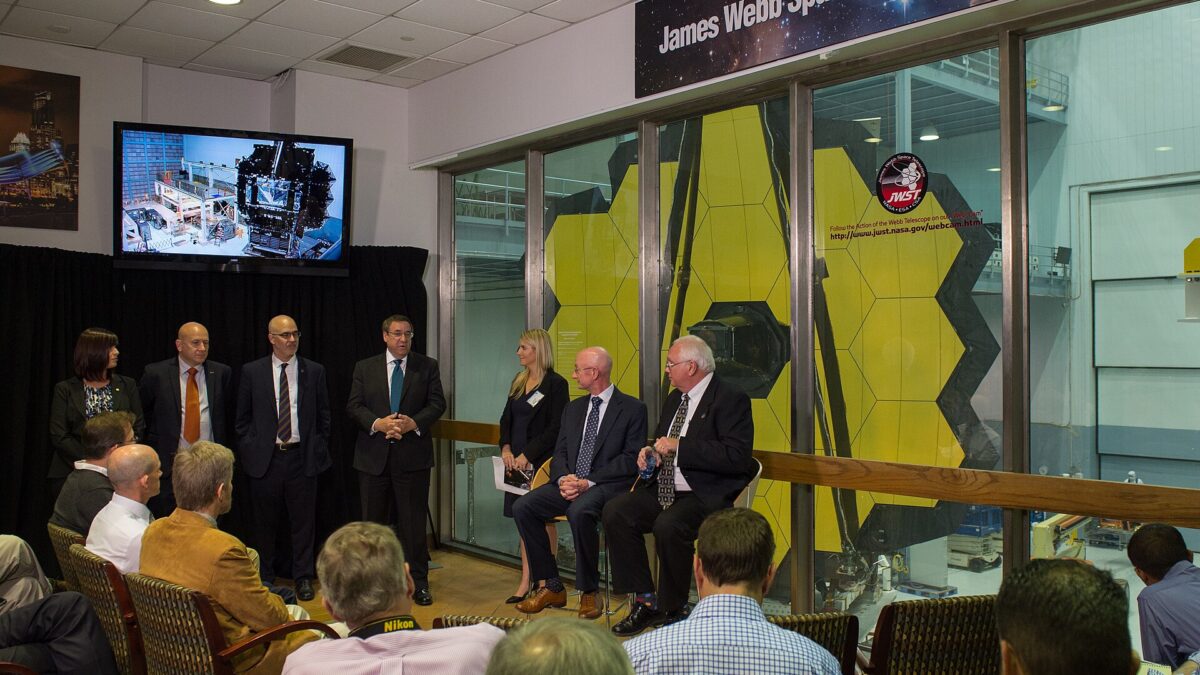
PASADENA, Calif., Nov. 5 (TodayViralUSA) — Astronomers have found a way to make NASA’s James Webb Space Telescope see faint planets it was previously unable to detect, not by changing the hardware but by building a digital copy of it.
The technique, described in a paper published Wednesday in the journal Nature, models the tiny imperfections in the telescope’s optics so precisely that researchers can subtract a star’s glare from images and reveal the dim planets orbiting nearby. In tests on archival data, it was two to 15 times more sensitive than standard methods, according to Caltech.
A ‘digital twin’ of Webb’s camera
Directly photographing exoplanets is notoriously hard because a star can outshine its planets by enormous margins, and even a coronagraph, a mask that blocks a star’s light inside the telescope, cannot remove the glare entirely.
The team, led by Northwestern University graduate student Rodrigo Ferrer-Chavez, built a detailed physical model of Webb’s Near Infrared Camera, or NIRCam. Using optimization tools borrowed from machine learning, they solved for millions of possible small defects and instabilities that could affect a given observation, producing an accurate picture of what each star’s glare should look like. The method is called Physics-based Learning for Imaging Planets, or FLIP.
“What’s exciting is that we’re showing how computation can help overcome limitations of the telescope itself,” said co-author Katie Bouman, a Caltech professor of computing and mathematical sciences, electrical engineering and astronomy.
A hidden planet comes into view
When the researchers reprocessed existing Webb observations, FLIP revealed the giant planet 51 Eridani b at a wavelength of 4.3 micrometers, where earlier analyses of the same data could not pick it out from its star’s glare, Science magazine reported.
“We now have a tool that lets us discover and study planets that we were not able to ‘see’ before, even if that planet was already in an image in the JWST archive,” Ferrer-Chavez said.
Implications for the search for life
The researchers say the approach is not limited to Webb and could be applied to NASA’s Nancy Grace Roman Space Telescope and to ground-based observatories. It could also help shape NASA’s planned Habitable Worlds Observatory, which is intended to photograph Earth-like planets around Sun-like stars, a goal that requires picking out objects roughly 10 billion times fainter than the stars beside them.
“I feel we just unlocked a new frontier,” said co-author Jason Wang, a Northwestern astronomer. “We’ve now gone beyond the telescope stability limit for the first time.”
Sources & Credits
- Caltech: Erasing the Stars to Find Exoplanets
- Science: Astronomers sharpen JWST’s view of distant worlds
- Scientific American: NASA’s James Webb Space Telescope is wobbly—scientists have a fix that could reveal new alien worlds
Image: The James Webb Space Telescope’s primary mirror revealed at NASA Goddard Space Flight Center, November 2016 (file photo), by NASA Goddard Space Flight Center / NASA/GSFC/Bill Hrybyk, public domain, via Wikimedia Commons.
Join the conversation