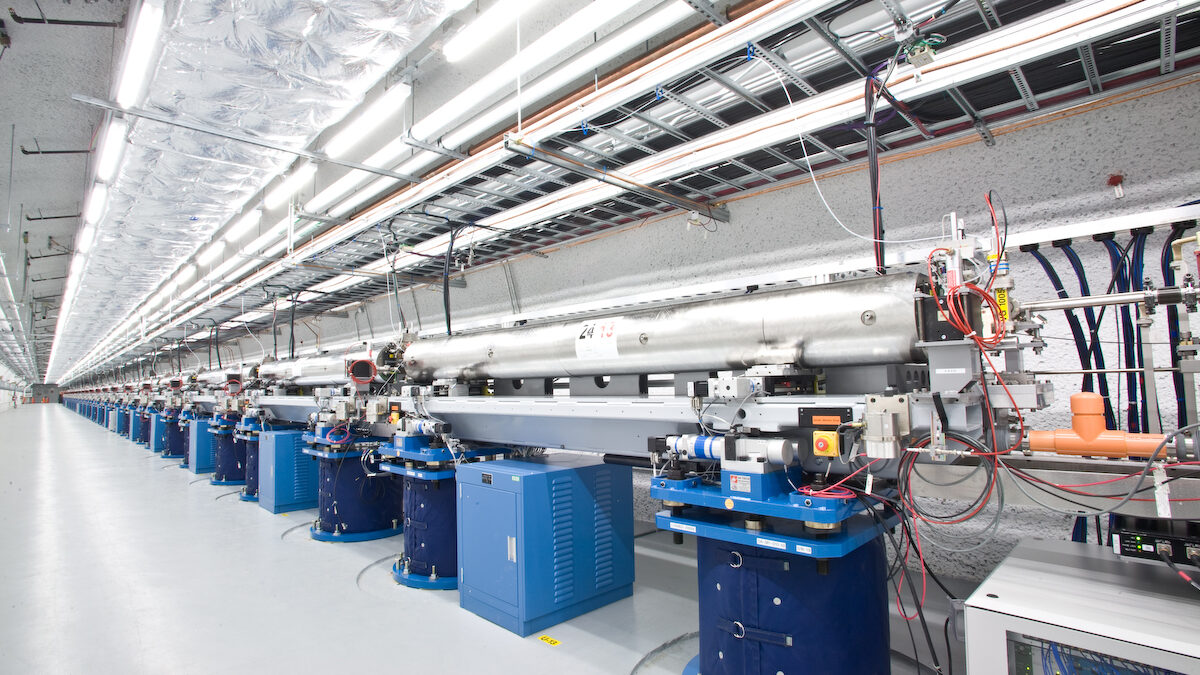
The U.S. Department of Energy has selected SLAC National Accelerator Laboratory for funding under a $30 million push to build “self-driving” photon-science labs — a response to X-ray lasers that now produce data faster than human teams can analyze it.
The project, called SPIRE (Source-to-Discovery Platform for Instrumentation, Robotics, and Embodied AI), was announced with other Genesis Mission awards at the Golden Age of Science Summit in Washington. It aims to let AI agents run experiments from sample handling through analysis at SLAC’s Linac Coherent Light Source and Stanford Synchrotron Radiation Lightsource.
Data faster than humans can read
LCLS-II’s superconducting upgrade can fire up to a million X-ray pulses a second. At full power, detectors can stream more than a terabyte per second — roughly equivalent to a thousand feature films every second. SPIRE lead principal investigator Angelo Dragone said autonomous lab design can open new discovery paths and sharply cut the time from experiment to insight.
Engineers plan to embed decision-making in detector chips within microseconds of acquisition, so noisy data is filtered at the edge before it floods downstream systems. A separate control layer would retune beam energy, brightness and focus from live detector feedback, replacing hours of manual iteration between the control room and experimental stations.
Robots for fragile samples
The hardest piece is physical handling. Protein crystals, tiny fusion targets and other fragile specimens vary too much for today’s single-task robots. SPIRE partners with Stanford robotics labs to train “embodied” systems that use tactile and visual sensing for context-aware moves, while hard-wired safety limits and human-set scientific goals remain in place.
SPIRE is one of four national-lab projects in the Robotics and Automation Testbeds solicitation, alongside work at Argonne, Oak Ridge and Brookhaven. Only $2 million of the $30 million total is allocated in fiscal 2026, with later years subject to appropriations. The broader Genesis Mission has backed more than $320 million in related investments this year, with a goal of doubling U.S. science productivity within a decade.
Sources & Credits
Reporting based on: Tech Times (Edward Northmore, Oct. 11, 2026); SLAC National Accelerator Laboratory materials.
Image: First light at the Linac Coherent Light Source — SLAC National Accelerator Laboratory / Wikimedia Commons (public domain).

Join the conversation