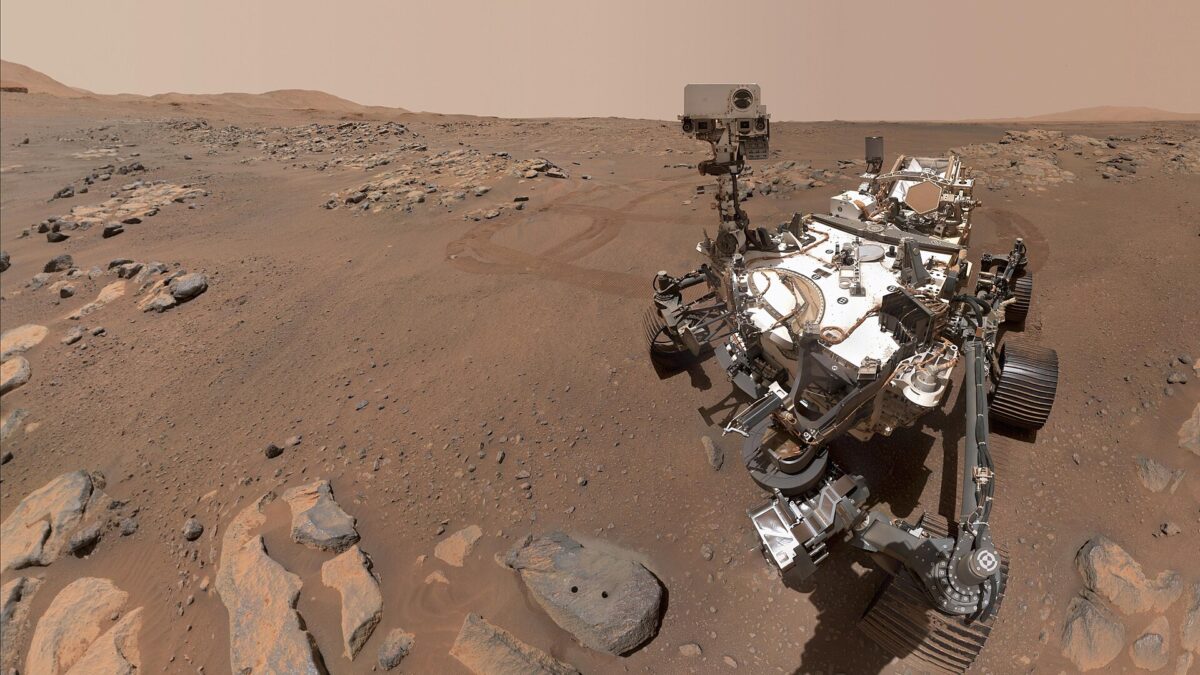
NASA’s Perseverance rover has driven farther than any vehicle has ever traveled on the surface of another world, logging 45.2 kilometers (about 28 miles) on Mars and overtaking the long-standing record set by the agency’s Opportunity rover, NASA said Tuesday.
The six-wheeled, car-size rover passed the milestone five and a half years into its mission, edging beyond the roughly 45 kilometers Opportunity covered between 2004 and 2018. Both rovers have also outdistanced every lunar rover sent to the Moon.
Built to keep going
Mission managers say the rover is far from finished. “Perseverance’s engineering hardware and instruments are in excellent shape with all redundant systems still available,” Steven Lee, project manager for NASA’s Perseverance and Curiosity rovers at the Jet Propulsion Laboratory in California, told Reuters. A recent review, he said, concluded the systems can operate “well into the 2030s, likely beyond,” and the rover’s plutonium-based power source still has many years of useful energy.
Engineers are testing the rover’s mobility mechanisms to show they can support 100 kilometers or more of driving, with hardware qualification runs equivalent to 150 to 300 kilometers. The original mission plan called for only about 20 kilometers.
Self-driving on Mars
NASA credits much of that progress to AutoNav, the rover’s autonomous navigation system. About 90% of Perseverance’s drives are now carried out without human intervention: the rover takes stereo images of the terrain ahead, builds a 3D map and chooses the safest route to its goal. A dedicated co-processor lets it run that software almost continuously while moving, unlike earlier rovers that had to stop and “think” between drive segments.
Searching for signs of ancient life
Perseverance landed in Jezero Crater in 2021 to investigate whether the region, which once held a lake, ever offered conditions suitable for microbial life. Lee said its most significant result so far is the potential biosignature announced in 2025 in reddish rock, believed to be 3.2 billion to 3.8 billion years old, from an ancient river channel that fed the lake.
The record-setting drive came as the rover headed toward an area called Idubi, through terrain beyond the crater’s western rim nicknamed Lac de Charmes. Scientists hope the area will shed light on early planetary processes such as large meteorite impacts, and orbital data suggest parts of the rim once hosted hydrothermal systems with warm groundwater. “These areas may once have provided a warm, watery sub-surface environment conducive to life,” Lee said.
NASA recently extended the mission to continue exploring the crater rim through roughly the end of 2028.
Sources & Credits
Reporting based on: Reuters via The Straits Times; NASA Mars 2020 mission.
Image: “PIA24836 Perseverance’s Selfie at Rochette” by NASA/JPL-Caltech/MSSS, Public domain, via Wikimedia Commons.
Join the conversation