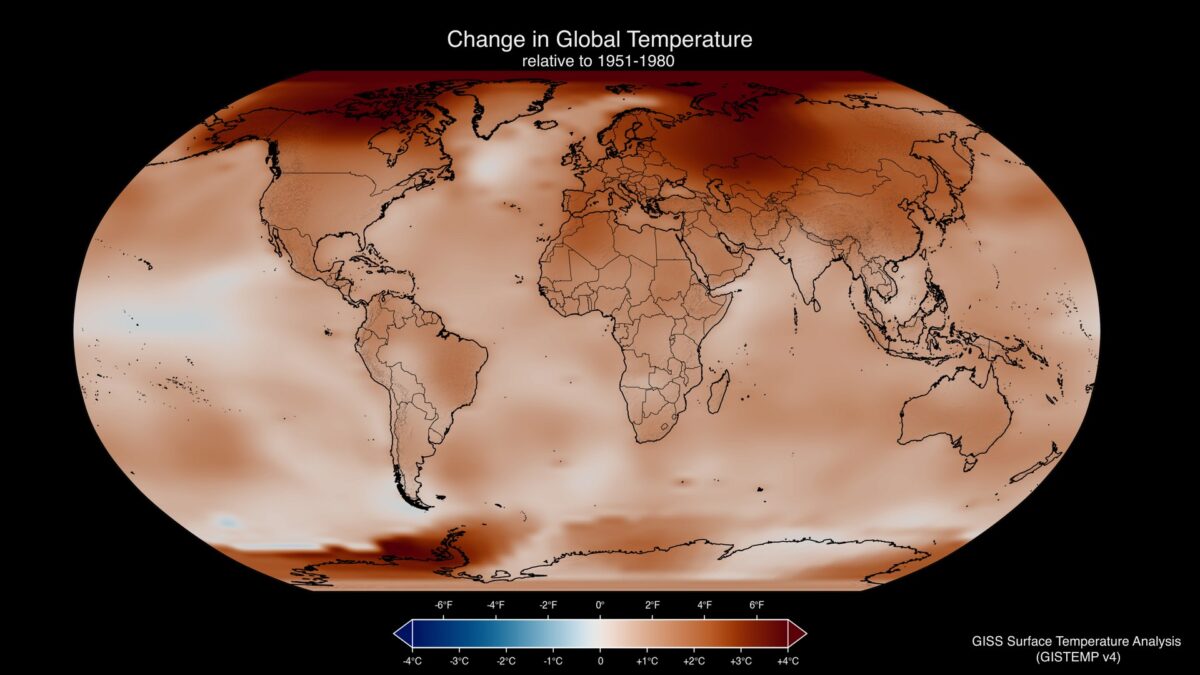
Evidence that human activity is driving global warming has grown stronger since the U.S. government first declared greenhouse gases a public-health threat in 2009, according to a major scientific review published Monday that directly rebuts a 2025 Energy Department report questioning the science.
The review, published in the American Geophysical Union journal Earth’s Future, was led by climate scientist Benjamin Santer of the University of East Anglia with co-authors from the Massachusetts Institute of Technology, Colorado State University, the University of Washington and the University of Edinburgh.
“The climate science that’s been published since the 2009 Endangerment Finding is now stronger than in 2009, the evidence is incontrovertible,” Santer said.
Tracing human ‘fingerprints’
The paper surveys more than three decades of climate “fingerprint” research, a field that uses the patterns and timing of climate changes to separate human influence from natural variability. The authors say those techniques can now detect a human signal throughout the climate system, from the upper atmosphere to the deep ocean.
They also note that the warming signal itself has strengthened: the period since 2009 includes the 10 warmest years in the instrumental temperature record, making the human contribution easier to distinguish from natural “noise.”
“These studies reveal that many independently monitored aspects of Earth’s climate have all been altered by global warming in physically consistent ways, just as we expect — from the top of the stratosphere to the depths of the world’s oceans,” said co-author Susan Solomon of MIT.
A direct challenge to the Energy Department
The review responds to a July 2025 Energy Department assessment that challenged the credibility of fingerprinting and questioned the scientific basis for the Environmental Protection Agency’s 2009 Endangerment Finding, the legal determination underpinning federal limits on greenhouse gas emissions. The authors call that report “deeply flawed,” arguing it ignored both the evidence available in 2009 and the advances made since.
The administration’s move to revoke the Endangerment Finding has raised concerns among health and environmental groups that it could unravel emissions rules and open the door to rolling back other environmental protections.
Extreme weather links
The review also addresses research linking human-caused warming to the changing frequency and intensity of extreme events such as heat waves, floods, wildfires and crop losses. “Methods have also been developed to understand how greenhouse gases have changed the frequency and intensity of extreme events,” said co-author Gabriele Hegerl of the University of Edinburgh.
Santer warned that the research field itself is under pressure. “A different kind of ‘Endangerment Finding’ is that the continuation of rigorous attribution science is endangered,” he said, describing it as “inconvenient science for those who seek a fossil fuel intensive future.”
Sources & Credits
Reporting based on: AGU Newsroom / University of East Anglia; Earth’s Future (study); Earth’s Future commentary on the DOE report.
Image: Global temperature change relative to 1951–1980, GISTEMP (file image) — NASA Scientific Visualization Studio / NASA GISS / Wikimedia Commons (Public domain).

Join the conversation