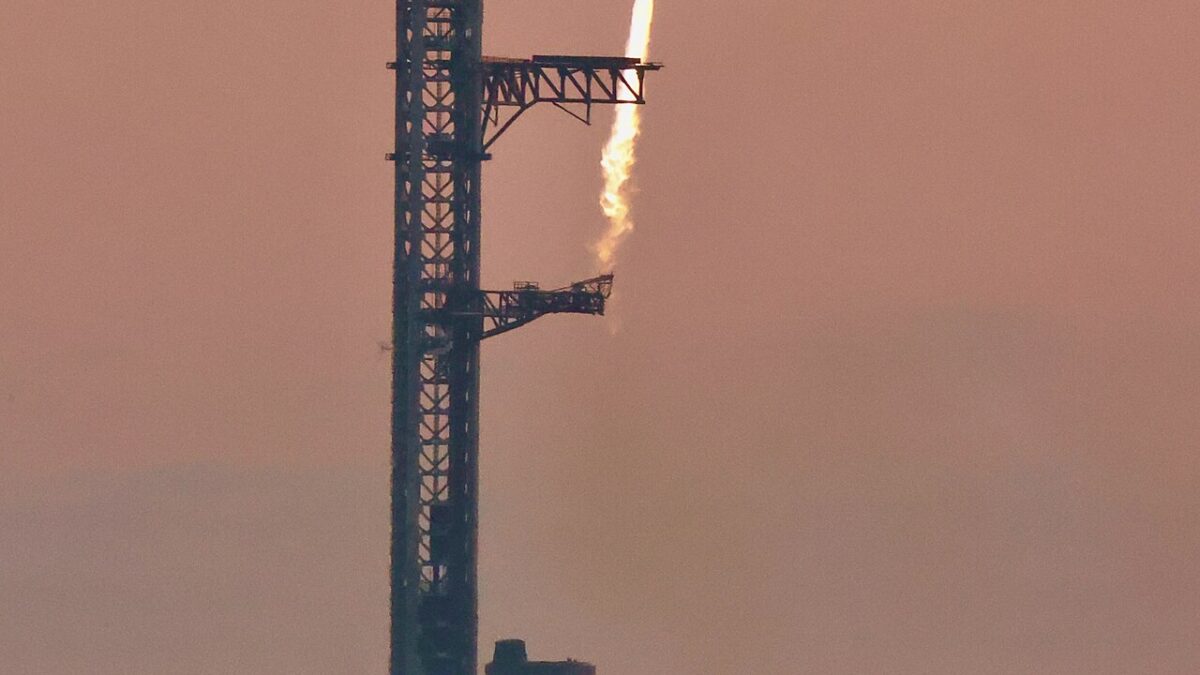
STARBASE, Texas, Nov. 14 (TodayViralUSA) — SpaceX on Saturday caught its Starship spacecraft in midair with the giant mechanical arms of its launch tower after nearly a day in orbit, the first time a spacecraft returning from space has been recovered that way and a major step toward the fully reusable rocket the company has spent a decade developing.
The upper stage touched back down at the same South Texas pad it left 22 hours earlier, settling upright into the tower’s grip at around 3:20 p.m. local time, the Houston Chronicle reported. “Can you believe it?” SpaceX commentator Dan Huot said on the company’s broadcast. “Look at her! Baby, she’s back!”
A homecoming after 14 laps
The 407-foot rocket lifted off Friday at 4:47 p.m. on the 15th flight of a full-scale Starship since 2023, and only its second trip to orbit. After separating from its booster, the spacecraft deployed 26 of SpaceX’s larger Starlink V3 satellites and circled Earth about 14 times at an altitude of roughly 165 miles, far longer than the few hours it spent in space on the previous test.
On the way home, the vehicle flew over northern Mexico, skirted populated areas and passed South Padre Island before approaching Starbase from the Gulf, announcing itself with a sonic boom. It slowed with a belly-flop maneuver, then reignited engines to swing upright for the catch. SpaceX said the spacecraft’s systems, including its critical heat shield, appeared to perform well.
Lars Blackmore, a senior SpaceX engineer, said on the broadcast that once the vehicle crossed over land there was a 21-minute window in which operators could not intervene. “So we’re just going to be holding our breath for that time,” he said.
The booster that got away
The mission fell short of SpaceX’s goal of catching both stages. Shortly after Friday’s launch, the Super Heavy booster’s engines shut down too early on its return, according to SpaceX’s Kate Tice. Its guidance system detected it was out of position and diverted it toward the Gulf of Mexico, where its flight termination system destroyed it. Elon Musk said on X the booster was “slightly low on fuel,” and that the company could not risk damaging the launch pad, which could have delayed the next flight by two to three months. Engineers are still investigating.
SpaceX has previously caught the Super Heavy booster three times, most recently in March 2025.
Why it matters
Recovering both stages intact is central to Musk’s plan to cut launch costs by flying the same hardware again quickly. NASA is paying billions of dollars for Starship to land Artemis astronauts on the moon and help build a lunar base. “It was almost magic,” NASA Administrator Jared Isaacman wrote on X.
SpaceX expects to begin launching Starships from NASA’s Kennedy Space Center in Florida within months. NASA is targeting as early as 2028 for Artemis IV, which would be the first crewed moon landing since the Apollo era.
Sources & Credits
- PBS News / Associated Press: SpaceX’s Starship returns from orbit and is captured by launch pad arms in a dramatic first
- Houston Chronicle: SpaceX catches Starship spacecraft returning from orbit in historic first for company
- CNBC: SpaceX, in a historic first, catches upper stage of its Starship rocket
- Reuters via The Jerusalem Post: SpaceX catches Starship spacecraft at Texas launch tower for first time
- NBC News: SpaceX launches 15th Starship flight; aborts booster recovery maneuver
Image: A Super Heavy booster returning to the Starbase launch tower during Starship Flight 5 (file photo, Oct. 2024), Steve Jurvetson, CC BY 2.0, via Wikimedia Commons.

Join the conversation