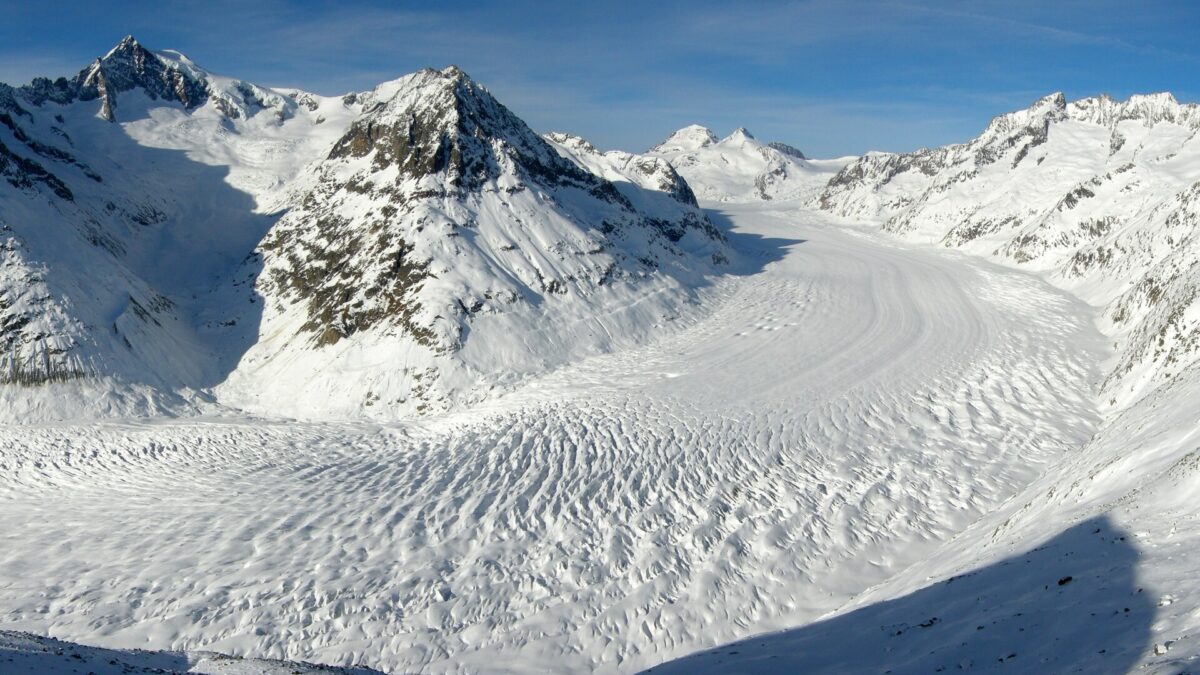
ZURICH, Oct. 4 (TodayViralUSA) — Switzerland’s glaciers lost 5.5% of their remaining ice volume in 2026, the second-largest annual percentage decline on record, according to new measurements from Glacier Monitoring Switzerland (GLAMOS), a network based at ETH Zurich and partner universities.
The loss followed one of the ten least snowy winters since monitoring began and a summer of prolonged heat. Hot, dry conditions from May through September drove melt to the highest elevations. On 76 days, heat waves pushed the freezing level above 4,000 meters — more than twice the long-term average and a Swiss record, ETH Zurich reported. By September, snow cover had vanished even at 3,500 meters, leaving bare ice exposed to further melt.
Average glacier thickness fell by roughly 2.5 to 4 meters this year, with some tongues losing up to 10 meters of ice. The hydrological year’s mean mass balance was about –2.9 meters water equivalent, GLAMOS said — extremely negative, though short of the record melt rates of 2022. Over the past five years, Switzerland has lost nearly 20% of its total glacier volume, with 2022–2026 melt rates more than twice those of any previously monitored five-year span.
Small glaciers vanish
Several smaller glaciers disappeared completely, including Bella Tola in Valais and Griessfirn in Glarus. Larger systems such as the Rhône, Aletsch and Clariden glaciers recorded their greatest melt on record in 2026, according to the Swiss Academy of Sciences summary tied to the GLAMOS annual report.
Meltwater temporarily eased summer water stress. From July to September, Swiss glaciers released about 2,200 billion liters of water — more than four times annual household drinking-water use in Switzerland. Scientists caution that this “old water,” stored in ice for decades or centuries, is an unsustainable buffer: as glacier area shrinks, the same relief will not be available in future heat waves for irrigation, hydropower and low-flow river shipping.
Glaciologists say Alpine temperatures are now too warm for many glaciers to recover. Bare ice absorbs more solar energy than snow-covered surfaces, accelerating losses once the winter snowpack fails. Reports also note collapse pits on glacier tongues where cavities give way, further speeding retreat.
The findings arrive as Alpine communities weigh tourism, hydropower planning and hazard risks linked to thinning ice and warming permafrost. For researchers, the 2026 total — just behind 2022’s roughly 5.9% volume loss — confirms that extreme annual melt is no longer a one-off anomaly but a recurring feature of the current climate.
GLAMOS measurements covering 23 glaciers in September underpin the national extrapolation. Detailed figures are published in the network’s 2025/2026 annual mass-balance report.
Sources & Credits
- ETH Zurich / GLAMOS: Devastating year for Switzerland’s glaciers
- BBC: Swiss glaciers suffer 'disastrous' year of ice loss
- Associated Press via Washington Post: Swiss glaciers lose over 5% of ice volume in 2026
Image: Tobias Alt, Tobi 87, CC BY-SA 4.0, via Wikimedia Commons.


Join the conversation