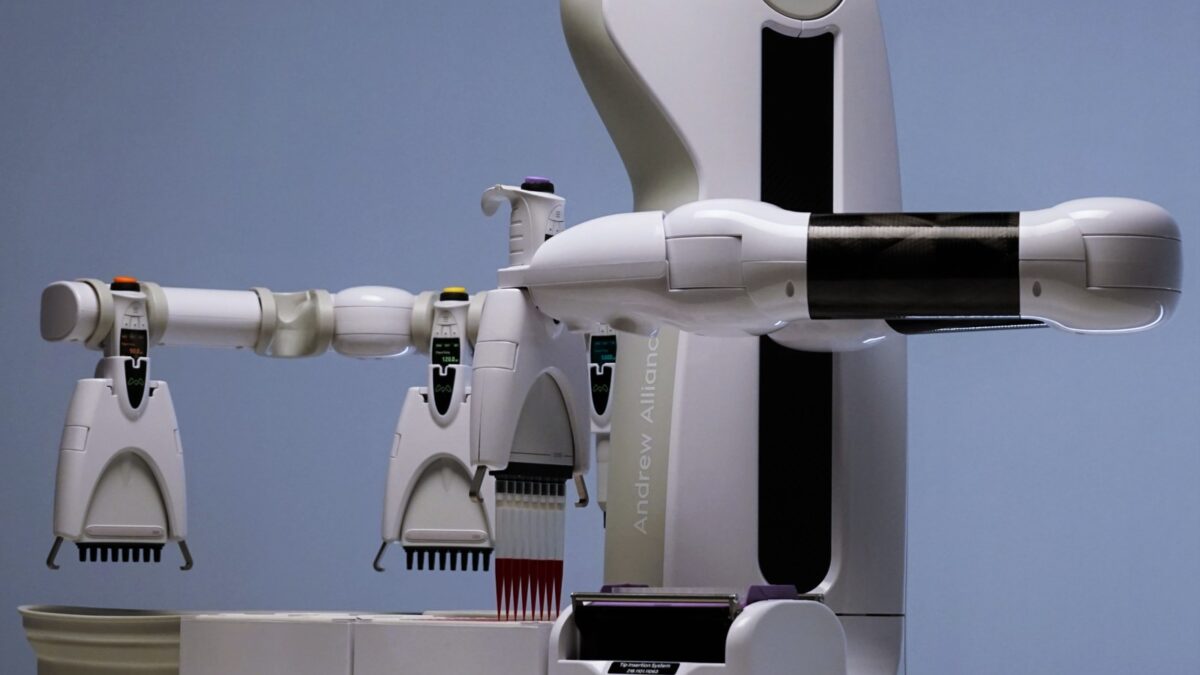
GOTHENBURG, Sweden, Oct. 2 (TodayViralUSA) — Researchers in Sweden say they have built an “AI scientist” that can propose biological hypotheses, design laboratory experiments, run them through robotics and interpret the results with limited human intervention, Euronews reported, citing a study involving Chalmers University of Technology and the University of Gothenburg.
The system links multiple large language models, scientific databases and physical lab robots into a closed loop. After analyzing a database of about 60,000 phenotypic, physiological and metabolic relationships for baker’s yeast (Saccharomyces cerevisiae), the software generated nearly 2,000 testable predictions about how nutrients affect cell growth and stress resistance, according to study author Ievgeniia Tiukova of Chalmers.
“It is too much information for a human to analyse, but our AI scientist could identify promising biological questions, recommend experiments to test them, evaluate experimental outcomes and iteratively refine its understanding based on new evidence,” Tiukova said.
Selected hypotheses were turned into machine-readable instructions for lab equipment. When runs finished, the system checked whether predictions held, then updated or revised hypotheses that failed — a cycle the authors describe as generating new knowledge rather than only advising human researchers.
Automation and limits
Ross King of the University of Gothenburg, the study’s senior author, said AI scientists are expected to work alongside people to speed discovery in biology, medicine and biotechnology and to make better use of scarce lab time. The team argued that automation can reduce some forms of human bias, shorten research cycles and limit errors tied to incomplete protocol records or inconsistent conditions.
King stressed that people remain essential. “Humans will remain essential for setting priorities, interpreting broader contexts, developing research programmes and ensuring compliance with ethical rules,” he said. Future autonomous laboratories, he added, should become stronger collaborators on difficult biological questions rather than replacements for scientific judgment.
The yeast work is a controlled test bed: yeast genetics and metabolism are comparatively well mapped, and high-throughput robotics can execute many small experiments. Translating the approach to more complex human disease research would still require careful validation, specialized facilities and governance that the authors and outside institutions are only beginning to define.
Governance attention
International health authorities are already drafting expectations for AI in research. The World Health Organization recently issued recommendations for researchers, ethics committees, regulators, funders and policymakers on responsible AI-enabled health research. Meg Doherty, director at WHO’s Department of Science for Health, said artificial intelligence offers “unprecedented opportunities to accelerate health research,” while warning that innovation must be guided by ethical safeguards that protect dignity, rights and equity.
For now, the Swedish project illustrates how language models, databases and robots can be wired into an experimental loop that proposes, tests and revises ideas at machine pace. Whether similar systems can reliably tackle messier biomedical problems — and under what oversight — will be the next practical test of the approach.
Euronews: Swedish researchers create an ‘AI scientist’
Image: Pocar19, CC BY-SA 4.0, via Wikimedia Commons.


Join the conversation