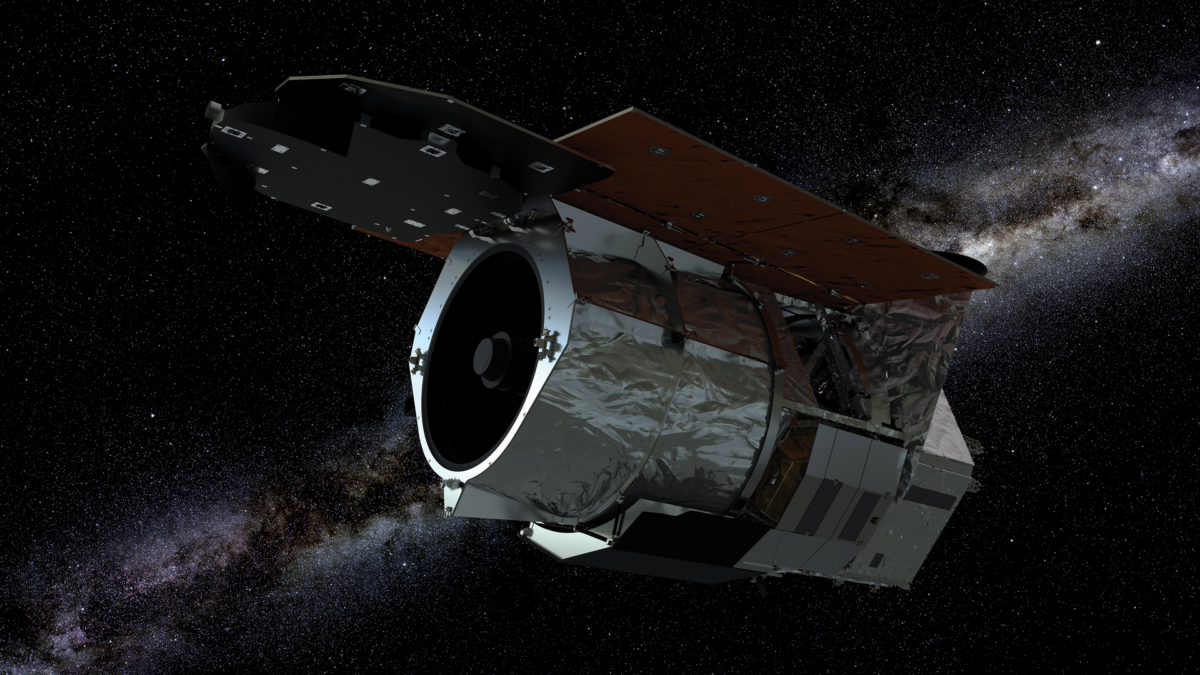
CAPE CANAVERAL, Fla. — NASA launched the Nancy Grace Roman Space Telescope on Sunday, sending the flagship observatory on a three-month, million-mile journey to study dark energy, dark matter and planets beyond the solar system.
The telescope lifted off at 7:26 a.m. EDT aboard a SpaceX Falcon Heavy rocket from Launch Complex 39A at Kennedy Space Center. The rocket separated from the observatory 31 minutes into the flight, and its side boosters returned to the launch site for reuse.
Ahead of Schedule, on Budget
NASA Administrator Jared Isaacman called Roman exactly the kind of success story the agency wants to see, noting that it was delivered ahead of schedule and on budget after more than a decade of work. He said the telescope would provide a new atlas of the universe.
Ground controllers at NASA’s Goddard Space Flight Center in Greenbelt, Maryland, began receiving data from the spacecraft seven minutes after launch. The team confirmed that the telescope’s solar panels and a lower instrument sunshade deployed about an hour and 23 minutes into the mission.
A Wider View Than Hubble
Roman carries a 2.4-meter mirror, the same size as Hubble’s, but its field of view is at least 100 times larger. NASA says it will be able to survey the sky up to 1,000 times faster than Hubble while maintaining similar sensitivity and infrared resolution.
That capability will allow astronomers to observe billions of cosmic objects. A central goal is to investigate why the expansion of the universe appears to be accelerating. One leading explanation is dark energy, an unexplained pressure that NASA estimates makes up about 68% of the content of the cosmos. Another possibility is that Einstein’s general theory of relativity breaks down across vast cosmic distances, and Roman is designed to test both ideas.
Mapping the Cosmos
Using its Wide Field Instrument, Roman will survey exploding stars known as supernovae, measure the growth of galaxy clusters and map the three-dimensional positions of millions of galaxies, peering back to when the universe was only about half a billion years old. It will also measure how the gravity of massive galaxies bends light from more distant objects, a technique that reveals the distribution of dark matter.
The mission will additionally search for exoplanets and carries a coronagraph to demonstrate technology for directly imaging planets around other stars, a step toward the search for life beyond the solar system. Nicky Fox, head of NASA’s Science Mission Directorate, called Roman a discovery machine that will make the invisible visible.
Next Steps
Roman is headed to the second Sun-Earth Lagrange point, known as L2, about 1 million miles from Earth, where the James Webb Space Telescope also operates. After arrival and a period of commissioning, the observatory is expected to begin science operations, with first images anticipated in early 2027.
The telescope is named for Nancy Grace Roman, NASA’s first chief of astronomy, who is widely credited as a driving force behind the Hubble Space Telescope.
Sources & Credits
- NASA: NASA's Dark Universe-Seeking Nancy Grace Roman Space Telescope Launches
- NASA Science: Why the Roman Space Telescope?
Image: IMAGE: NASA, NASA-GSFC, Public domain, via Wikimedia Commons.

Join the conversation