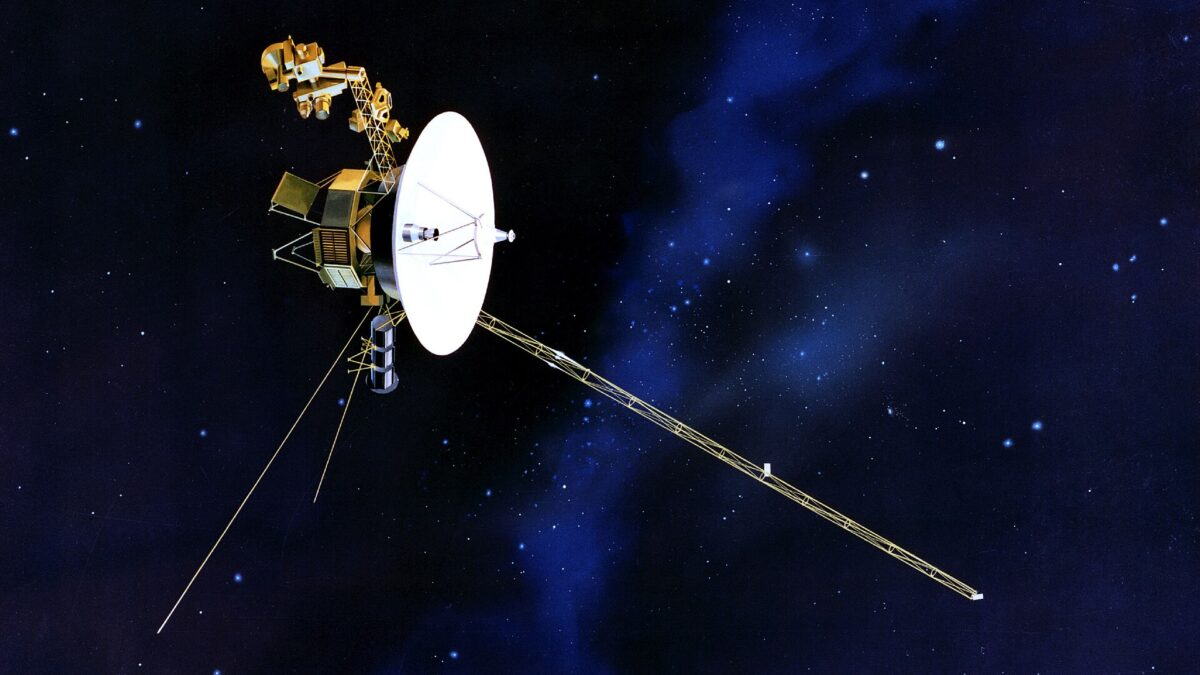
PASADENA, Calif., Nov. 19 (TodayViralUSA) — NASA’s Voyager 1 has become the first spacecraft to travel one light-day from Earth, the agency confirmed on Thursday, a milestone reached after more than 49 years of uninterrupted flight.
A light-day is the distance light travels in 24 hours, about 16.1 billion miles (25.9 billion kilometers). NASA said the probe crossed that threshold at 2:16 a.m. PST (5:16 a.m. EST) on Wednesday, Nov. 18. Because its radio signal travels at the speed of light, mission controllers at NASA’s Jet Propulsion Laboratory in Southern California did not hear the confirming transmission until early Thursday, a full day later.
A signal from interstellar space
The signal was received in Madrid through NASA’s Deep Space Network, the agency’s global array of large antennas, Reuters reported. The milestone came 49 years, two months and 11 days after launch.
“After 16 billion miles of exploration, Voyager 1 continues its journey into the unknown,” NASA engineer Nshan Kazaryan said at JPL as the confirmation was announced.
The achievement comes with a complication. NASA said the team has not received science and engineering data from Voyager 1 since Nov. 14. The spacecraft is still transmitting a carrier signal, which normally conveys that data, and engineers used it together with trajectory calculations to confirm the milestone while they continue to investigate the problem.
Nearly half a century of discovery
Voyager 1 and its twin, Voyager 2, launched in 1977 to take advantage of a rare planetary alignment and returned the first high-resolution images of Jupiter and Saturn. In 2012, Voyager 1 became the first spacecraft to leave the heliosphere, the protective bubble of particles and magnetic fields generated by the Sun, and enter interstellar space. Voyager 2 crossed that boundary in 2018.
“The Voyagers are revolutionizing our understanding of interstellar space,” said Linda Spilker, Voyager project scientist at JPL. “One big surprise is the extent to which our Sun continues to affect interstellar space, all the way out to Voyager 1.”
Joe Westlake, director of NASA’s Heliophysics Division, said the mission “would be remarkable just for what it contributed to planetary science,” but has since become central to NASA’s study of the Sun.
Running on borrowed time
Traveling at about 38,000 mph, Voyager 1 is powered by a radioisotope thermal generator that converts heat from decaying plutonium into electricity. Both probes lose about 4 watts of power each year. Earlier this year, engineers switched off three devices on Voyager 1 and replaced them with lower-power alternatives, a step NASA expects will keep current science instruments operating on both spacecraft until at least their 50th launch anniversaries next summer.
“We’re one light-day, but we are definitely not done yet,” Voyager project manager Suzanne Dodd said, according to Reuters. Voyager 2, which NASA described as healthy, is expected to reach the same distance in November 2035.
For scale, NASA noted that sunlight passing Earth takes about 1.3 seconds to reach the Moon, about four hours to reach Neptune and roughly another 20 hours to reach Voyager 1.
Sources & Credits
- NASA: NASA’s Voyager 1 makes history reaching one light-day from Earth
- NASA Science: Voyager 1: What is a light-day
- Reuters via Investing.com: NASA probe achieves light-day milestone and is ‘not done yet’
- The Associated Press: NASA’s Voyager 1 phones home from one light-day away
Image: Artist’s concept of a Voyager spacecraft in flight. NASA/JPL, public domain, via Wikimedia Commons.

Join the conversation