ANTWERP, Belgium, Nov. 18 (TodayViralUSA) — A class of advanced materials that won the 2025 Nobel Prize in Chemistry turns out to have been invented by nature long before chemists got there, according to a new study of microbes that conduct electricity through the mud of rivers and seabeds.
An international team led by the University of Antwerp found that cable bacteria build their internal wiring from a nickel-based metal-organic framework, or MOF, the first time such a material has been identified in a living organism, the UK’s Diamond Light Source synchrotron facility said on Tuesday. The findings were published in the journal Nature Communications.
‘Stupefied’ by the find
“We were totally stupefied when we found out that a MOF structure was present in our bacteria,” said Filip Meysman, a biologist at the University of Antwerp who leads the research consortium. “Somehow evolution came up with exactly the same idea as the Nobel Prize chemists.”
MOFs are highly ordered materials in which metal ions act as joints and organic molecules act as linkers, forming a repeating, building-block structure. By varying those components, chemists design MOFs to capture carbon dioxide, speed up chemical reactions or conduct electricity.
Living electrical cables
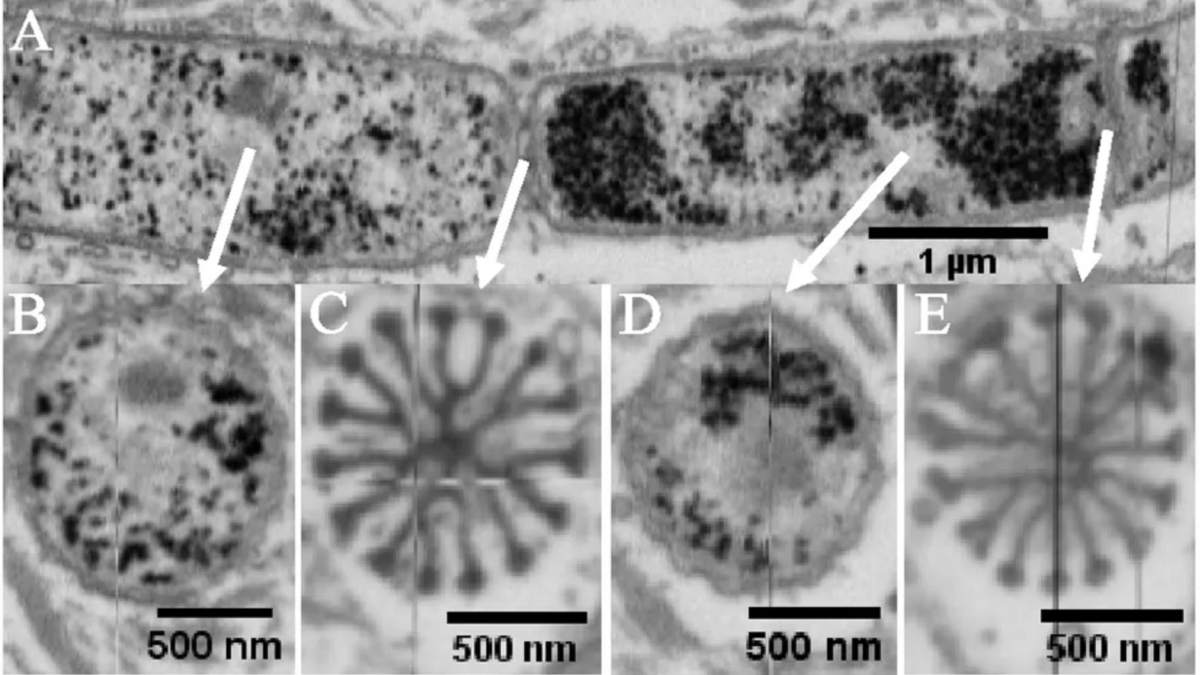
Cable bacteria, discovered about 15 years ago, are made of thousands of cells joined end to end into filaments several centimeters long. They carry electric current through 20 to 70 parallel protein fibers, each about 50 nanometers wide, letting them link oxygen at the sediment surface to chemical reactions deeper in the mud. How they conducted electricity so efficiently had remained a mystery.
“The cable bacteria have essentially a power-line network embedded in their cell envelope,” said Bent Smets, a doctoral researcher at the University of Antwerp.
Over more than five years, the team combined microscopy, spectroscopy, including work on Diamond’s I20 beamline, and theoretical modeling. They found that each conductive fiber resembles a smartphone charging cable roughly 20,000 times smaller, with a bundle of intertwined nanoribbons wrapped in a protective protein layer. The nanoribbons themselves are made of the nickel-based framework.
A model for greener electronics
The natural material’s electrical conductivity ranks among the best ever reported for a MOF, according to Diamond Light Source. The researchers said understanding how the bacteria assemble these structures could point to bio-based ways of producing MOFs and to new designs for sustainable electronic materials.
Sources & Credits
- Diamond Light Source: Scientists discover the first MOF made by nature
- Nature Communications: Highly efficient long-range conduction through a biosynthetic nickel-organic framework
Image: Cable bacterium filaments. Image by Cornelissen R, CC BY 4.0, via Wikimedia Commons.



Join the conversation