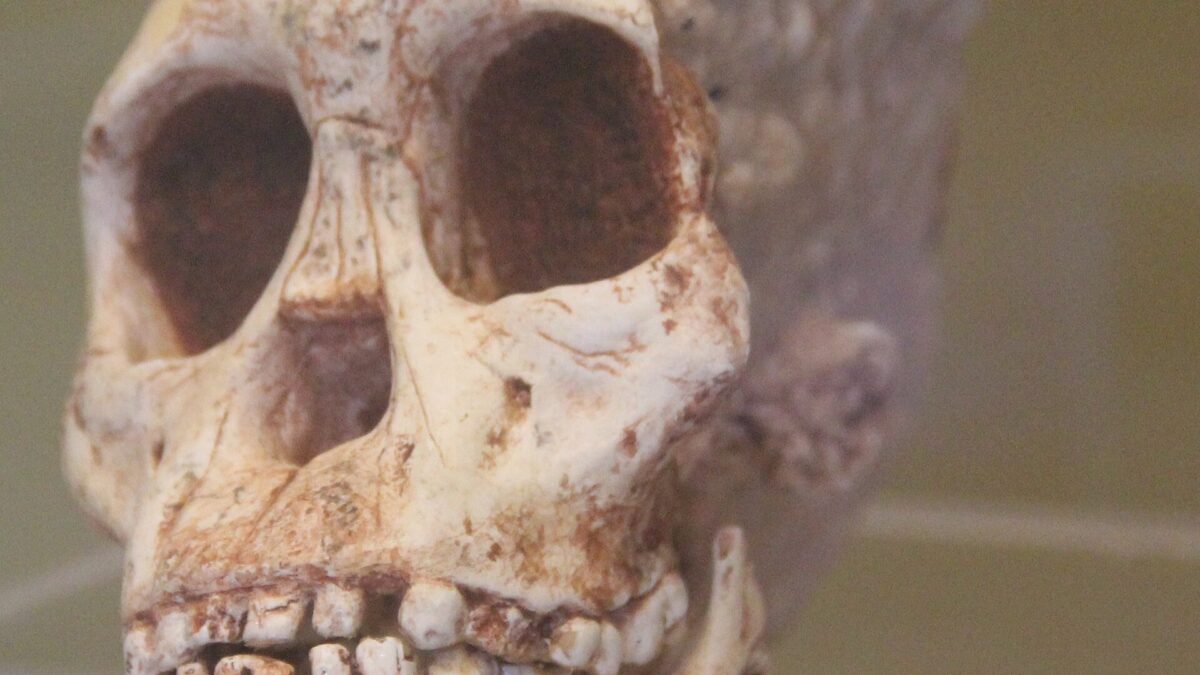
More than a century after it helped establish Africa as the birthplace of humanity, one of the most famous fossils in science is reshaping the story again. Researchers have dated the skull known as the Taung Child to between 2.96 million and 3.03 million years ago, and their analysis suggests that the early human family tree in southern Africa was far more complicated than scientists long assumed.
The international study was led by Professor Gabriele Macho of the Archaeology, Environmental Changes and Geo-Chemistry research group at Vrije Universiteit Brussel in Belgium. It was published this month in the journal npj Palaeoecosystems.
A one-of-a-kind specimen
The skull of a roughly 3-year-old child was found at Taung, South Africa, in 1924. It became the first solid evidence for humanity’s African origins and the “type specimen” used to define the species Australopithecus africanus, a human relative with a mix of ape-like and human-like features.
Yet scientists never set firm criteria for assigning later finds to the species. As a result, the Taung Child remains the only fossil that can be identified with certainty as A. africanus.
“For over 100 years, we assumed the Taung Child was just one of many similar fossils from the era,” Macho said in a statement. “Our findings turn that on its head. The human family tree wasn’t a neat, straight trunk — it was a chaotic, tangled bush driven by climate shifts.”
Clues in teeth and brains
The team compared tooth structure and patterns of brain and dental development during growth. They found that several adult fossils traditionally classified as A. africanus followed developmental paths that differ from the Taung Child’s.
The differences in brain development were especially telling. According to the researchers, they suggest that fossils grouped as a single species may in fact represent several distinct hominin species that lived in the Sterkfontein region, northeast of Taung, either at the same time or in succession.
Climate as an engine of diversity
The researchers believe repeated swings between wetter and drier climates in southern Africa drove that diversity. As habitats expanded and contracted, populations of early human relatives moved with them. Some became isolated and evolved separately; others later came back into contact and interbred.
The region’s position on the boundary between tropical and temperate ecosystems may have repeatedly brought different hominin groups together, creating opportunities for hybridization, the team said.
Fossilized pollen also points to a very different landscape from today’s. The area around Taung was considerably wetter and more heavily forested, with evidence of tree species now found hundreds of kilometers to the northeast.
Why it matters
Together, the findings challenge the traditional picture of human evolution as a fairly orderly progression from one species to the next. Instead, the researchers describe a shifting network of populations that separated, adapted, reunited and sometimes interbred, a more crowded and interconnected world that preceded the emergence of our own genus, Homo.
Sources & Credits
- ScienceDaily (Vrije Universiteit Brussel): A 3-million-year-old child just made human evolution far more complicated
- Gizmodo: Taung Child Fossil Shows Human Family Tree Was More Complex
- SciTechDaily: A 3-Million-Year-Old Fossil Is Turning the Story of Human Evolution Upside Down
Image: Replica of the Taung Child skull, Museum of Black Civilisations, Dakar. GuillaumeG, CC BY-SA 4.0, via Wikimedia Commons.

Join the conversation